Some teachers hand you information. A few hand you a whole new way of being in your body. davidji is the second kind for me.
If you’re on Insight Timer, you probably already know his voice. People call him the “Velvet Voice of Stillness” for a reason. He spent over a decade at the Chopra Center as lead educator and then dean of Chopra Center University, he wrote Secrets of Meditation, destressifying and Sacred Powers, and he’s taught hundreds of thousands of people to meditate.
Read the full articleClose article
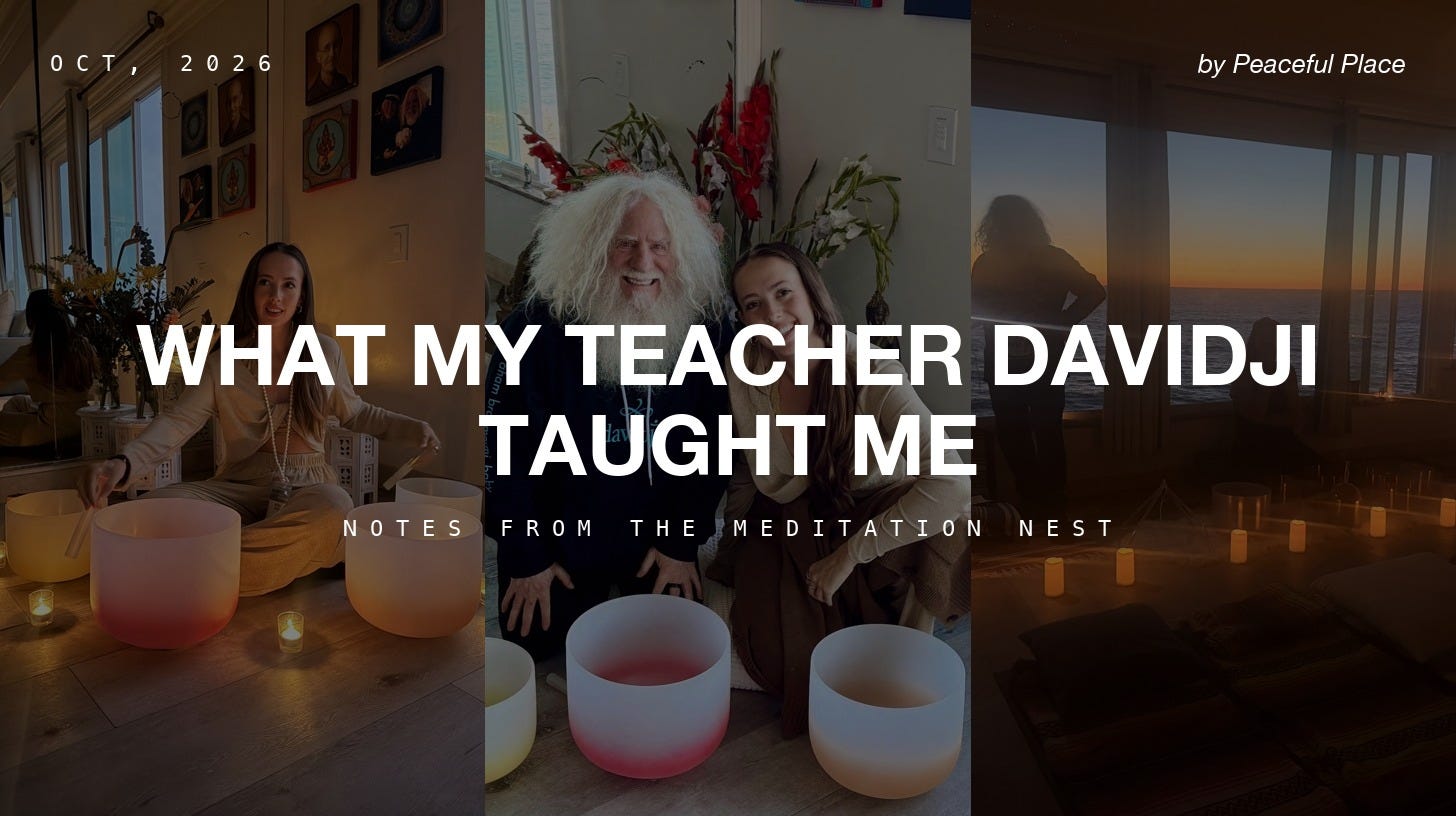
To me, he’s also my teacher and my mentor. This month he invited me to join his team at his Secrets of Meditation & Manifestation retreat in Carlsbad to hold the sound for his meditations and ceremonies.
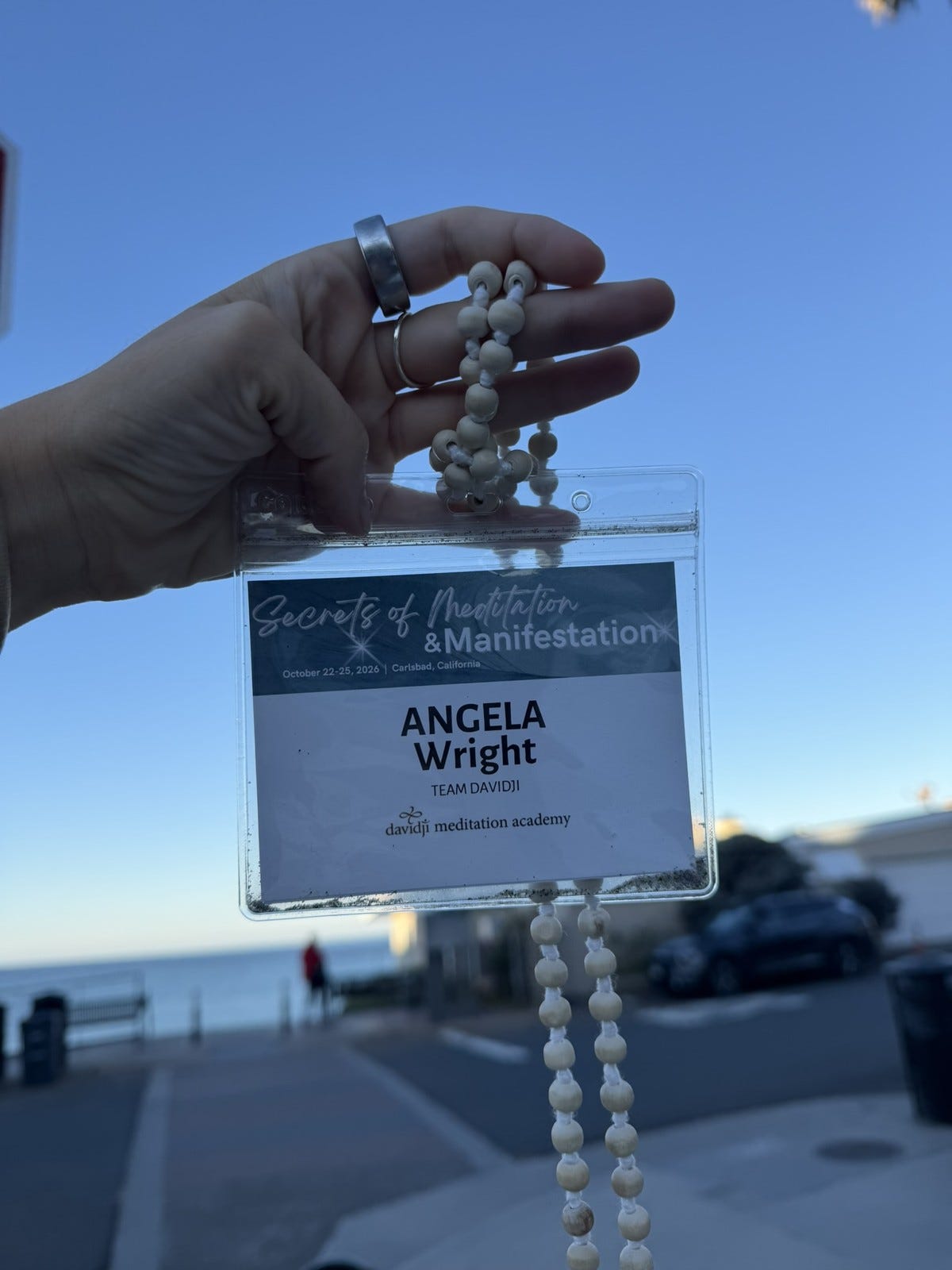
Four days at the Meditation Nest, right on the Pacific, in what he lovingly calls the “Sweet Spot of the Universe.” I brought my crystal bowls and my voice. He brought a lifetime of wisdom, a lot of jokes, and an unreasonable number of TV recommendations.
He’s not a fan of recorded music playing in the background. In front of the whole group he said he’s always preferred “vinyl” and having me be “all of my background music, no matter what’s going on.” Hearing that from my teacher, in a room full of people who have followed him for years? Still not over it.
So I’m writing it all down before it fades. Here’s what I learned. Grab a tea. This one’s long, in the best way.

1. Get still first. Then be brilliant.
davidji has read the Bhagavad Gita every single day since 2004. (Einstein, Thoreau, Emerson and Gandhi were fans too.) One of his favorite ideas from it, in his words: “Get still and then be brilliant.”
We usually do it backwards, right? Figure it out, fix it, push through, and then maybe rest. He flips it. Stillness isn’t the reward at the end. It’s the starting line.
2. Listen for the space between the waves
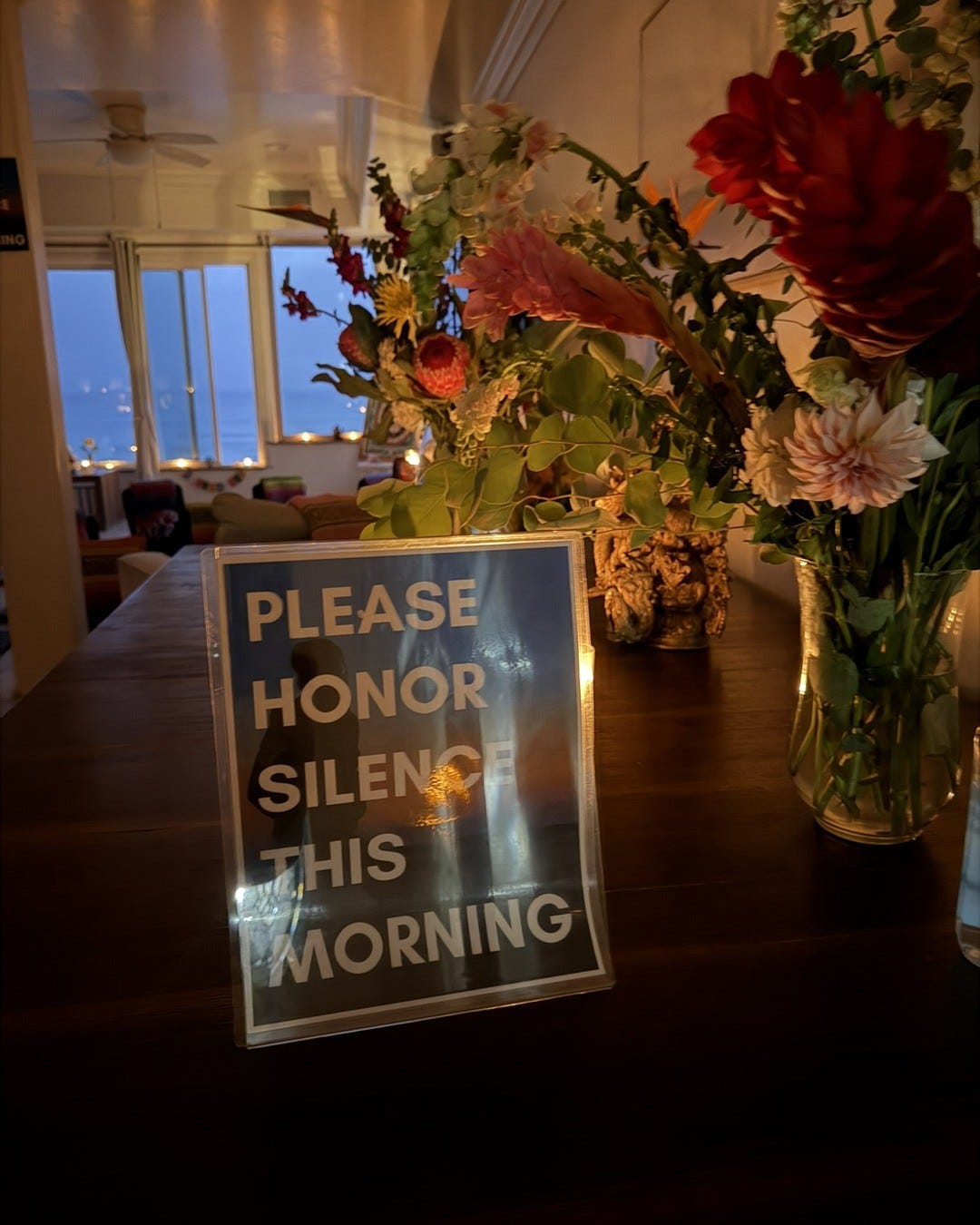
Every morning started in silence, by candlelight, facing the ocean. In one of the first meditations he had us just listen to the waves, and pointed out something I’d honestly never noticed: at the end of each wave, before the next one rolls in, there’s a flicker of silence.
That’s where meditation lives. In the gap. You don’t make it happen. You just notice it.
And he was really clear that it doesn’t matter how long you’re in there. A millisecond or fifteen minutes, same place. Nobody’s keeping score.
3. Ask the sacred questions
Before most meditations he guided us through a few questions. Not to answer them perfectly. Just to ask.
Who am I? The oldest question there is. Sometimes an answer comes, sometimes nothing does. Keep asking.
What am I grateful for? The people, the animals, the moments.
What does my heart truly long for? Hand on heart for this one. You’re asking your heart, not your head.
Then you pick one intention for the day and plant it in your heart like a seed. He reminded us it takes about a minute for your blood to travel through your whole body and back to your heart, so with every heartbeat that intention is washing through you. Then you let go of how it turns out. You planted it. Stillness waters it.
4. Know who’s in your front row
This one wrecked me (lovingly). He had us write down our “front row,” the five to eight people who root for us no matter what. Could include people who have passed. Could include your dog.
And everyone else? Start forgiving them. Not because what happened was okay, but because when we forgive, we free ourselves from the ties that bind us to the person who hurt us. “Closure’s overrated,” he said. You can make peace inside without the other person ever showing up for that big final conversation.
The conscious person is the one who gets to shift. Maybe the rest follow.
5. Swap “what’s next?” for “what’s now?”
He’s been doing this for about five months. Every time he’s about to ask “what’s next?”, he follows it with “what’s now?” He said it’s helped him skip so much self-imposed pressure to create things that didn’t even need to be created.
As a recovering what’s-next person, I felt extremely seen.

6. Mindfulness is three words: watch, witness, notice
He drew such a helpful line between mindfulness and meditation. Mindfulness isn’t about changing your state at all. You watch, witness and notice whatever is here, without judgment and with kindness. Thinking about that argument with your sister? Notice it. No scolding. Come back.
He also pointed out that a lot of modern mindfulness got stripped of its heart. The Buddha’s teachings always came with compassion attached.
7. Kindness starts with you (no, really)
Self-kindness, self-compassion, self-forgiveness, self-love. He was blunt about it: you can’t truly give those to anyone else until you’re giving them to yourself. Otherwise “it’s an act. It’s a pose.”
His practice: when the voice in your head says “you should have known better,” check if that’s the voice of shame. Could there be another voice? One that says you were young, you were trying to get through, you’l do better next time, and you’ve always done your best?

8. The original “may you be happy” is a ghost story
Loving-kindness (metta) comes from an old story about 50 monks the Buddha sent into the forest for the rainy season. The forest spirits got offended and tried to scare them off with horrible noises and smells. The monks ran back to the Buddha, who sent them right back with one practice: may you be well, may you be happy, may you be peaceful.
The spirits were so moved they ended up protecting the monks all season.
davidji’s advice: if you’ve got any ghosts in your house, or relatives who annoy you, this is what you should be doing. I laughed. Then I wrote it down.
9. Your body runs on an ancient clock
We got a full Ayurveda lesson (he warned us it could go down a rabbit hole, and it did, gloriously). The short version of the Ayurvedic clock:
6 to 10am, earth time: heavy and slow. Move your body.
10am to 2pm, fire time: digestion is strongest. Make this your biggest meal.
2 to 6pm, air time: the creative window. Writers, musicians, artists, this one’s ours.
6 to 10pm: heavy again. Wind down, try to be asleep by 10.
He also loves meditating first thing, before coffee, before the gym. His whole philosophy is the lowest barrier to entry, so the practice actually sticks for the rest of your life.

10. Match the breath to what you need
Someone asked about energizing breathwork and his answer was so refreshing. Want to spike your heart rate? Get up and move. Squats, a walk, jumping jacks. If you’re sitting on a cushion, let’s bring it all down.
He also explained that when we hyperventilate, the problem usually isn’t too little oxygen. It’s too little CO2, which narrows the blood vessels in the brain. Part of why slow nose breathing feels so good. (Breathe through your nose when you work out too. He’s serious. I’m working on it.)
11. Message, messenger, timing
Why do we suddenly change after hearing the same advice a hundred times? His take: the right message, from a messenger you trust, at the right time. A podcast, a book, a teacher, a voice on a meditation app. When all three line up, something clicks.
So if something in here lands for you, maybe it’s your timing. And if nothing lands, that’s okay too. It’ll come.
12. When you’re tired, rest
On the last morning he read a passage The Pivot Year by Brianna Wiest Here it is the way he read it:
When you’re tired, rest. When you’re motivated, act. When you’re inspired, create. When you’re hopeful, leap. When you’re doubtful, wait. When you’re ready, go.
Those feelings aren’t random. They open and close doors at just the right time. Listen to your body. Listen to your soul.

13. There are four paths, and you’re probably on all of them
From the Gita: knowledge (read, study, go deep), selfless service (help without needing a certain outcome), devotion (flow love into everything), and meditation (the “royal” path of stillness). Any one can take you home. Most of us are walking a little bit of each.
14. The ocean was the real teacher
By the last day our breathing had slowed so much that most of the room was down to just a few breaths a minute. davidji gave the credit away right away: the ocean had been teaching us the whole time. “Sweet mama O,” he called her.
And the community. A room full of people choosing to show up, be vulnerable and hold space for each other. You can’t plan that energy. You can only say yes to it.
What I’m taking home
Get still first. Ask the questions. Know your front row. Notice the space between the waves. Be kind to the voice inside. And when you’re tired, rest.
Thank you, davidji, for being my teacher, for trusting me with the sound, and for reminding all of us to come home to ourselves. Shanti, shanti, shanti. 🙏
My homework (things he recommended)
The Bhagavad Gita, the Jack Hawley translation. Open to one passage, sit with it, then meditate.
The Yoga Sutras of Patanjali, especially the parts on quieting the mind.
davidji’s books: Secrets of Meditation, destressifying and Sacred Powers.
Cloud Atlas, the movie. His “timeless classic.” Buy it so you get the bonus features.
Dan Siegel’s Wheel of Awareness, a free practice online.
Come meditate with me
If you found your way here from davidji’s world, welcome. I’m so glad you’re here.
Follow me on Insight Timer: free sound baths and meditations, with new ones every couple of weeks. Hit follow so they show up for you. insighttimer.com/Peacefulplacewellness
Free full-length sound baths on YouTube: youtube.com/@peacefulplacewellness
Daily breath + sound on Instagram: @peacefulplacewellness
Classes in LA: my class schedule
Bring a sound bath to your team or event: reach out here
Here’s one to start with tonight, a sound bath for when your thoughts won’t stop:
With love,
Angela
This essay first appeared on my Substack. Subscribe for new writing on sound, rest and the nervous system.
Subscribe on Substack