Earlier this year, I found myself sitting cross legged in an ashram in Rishikesh, India listening to Sadhviji Bhagawati Saraswati speak about suffering, service, spirituality, and what it truly means to live in peace.
Read the full articleClose article
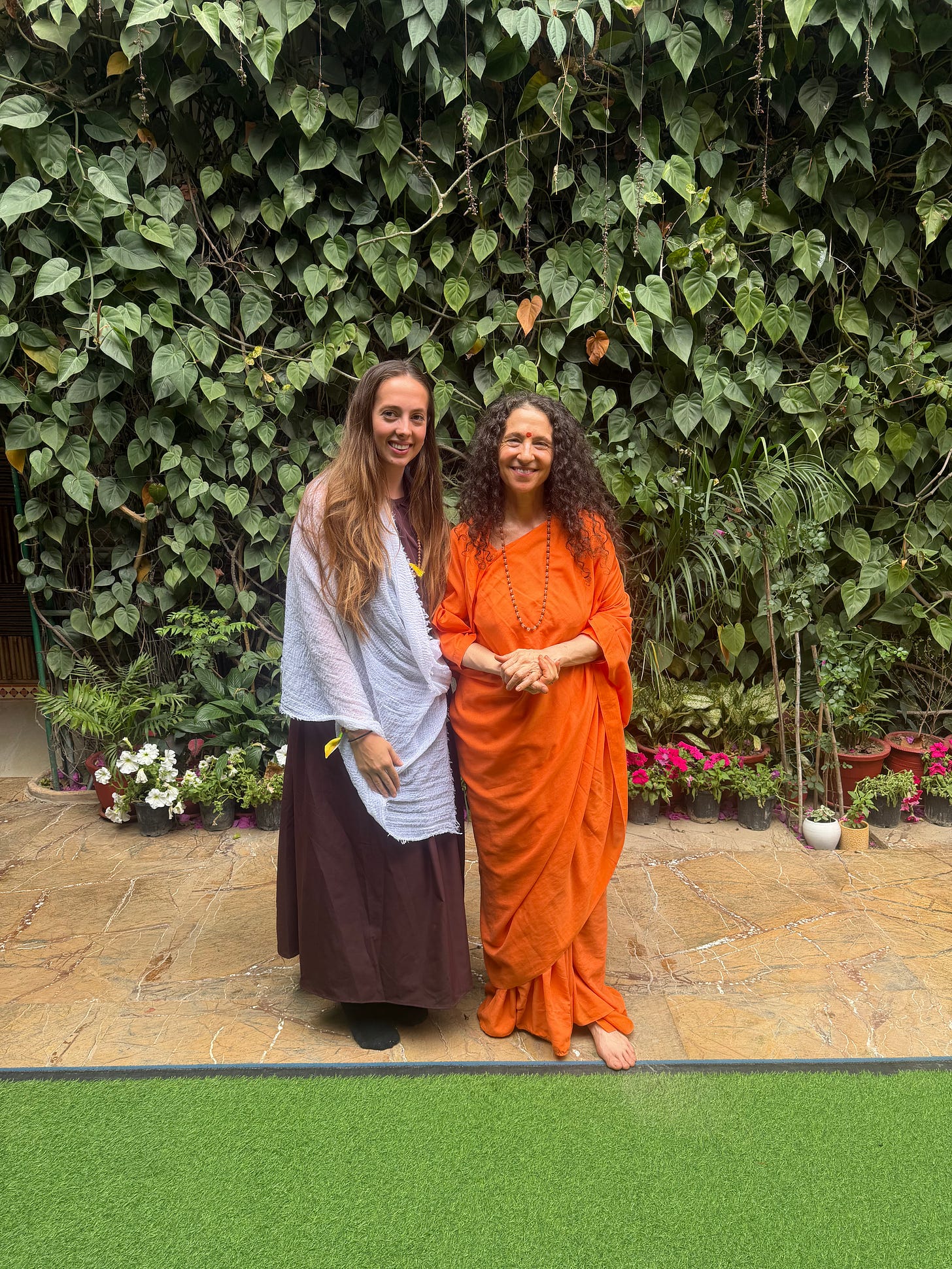
Months later, I found myself hearing her words again, this time not on the banks of the Ganges River, but inside the Los Angeles wellness studio where I teach sound baths, meditation and Yoga.
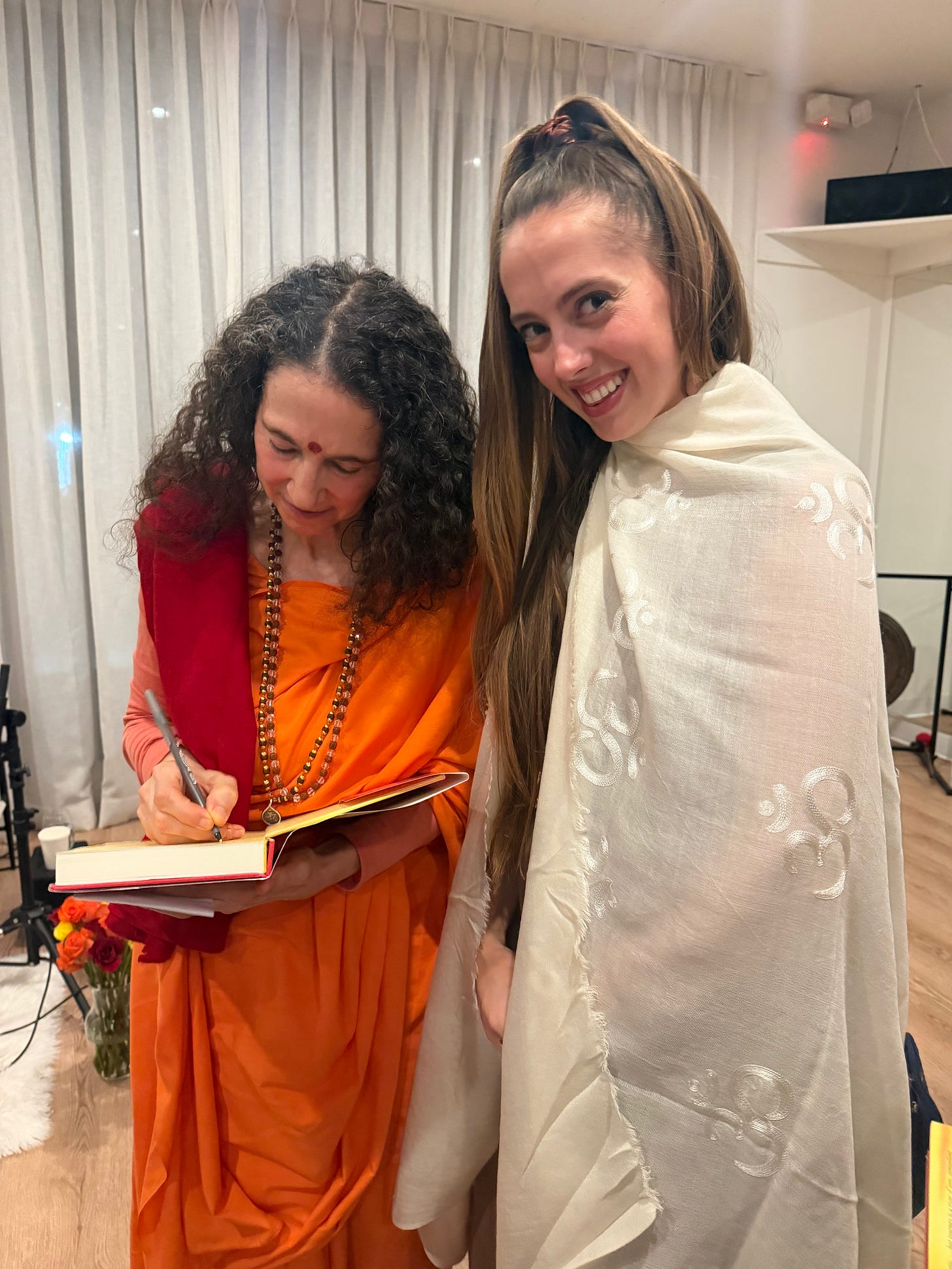
And strangely, the message felt even more relevant here.
Because while modern life may look different in different places, so many of us are still struggling with the same things.
Stress.
Burnout.
Loneliness.
Disconnection.
Comparison.
Emotional exhaustion.
The feeling that no matter how much we achieve, produce, consume, or optimize ourselves, something still feels missing.
Throughout the evening, Sadhviji spoke about yoga, spirituality, community, and the human tendency to search for fulfillment outside of ourselves.
But what struck me most was how deeply applicable these teachings still are in modern life.
Not as religion.
Not as dogma.
Not as something distant or inaccessible.
But as practical tools for navigating what it means to be human.
The Healing Power of Community
One of the first things Sadhviji said that stayed with me was:
“The answer to that which ails us, on individual levels, on collective levels, on global levels, is gathering in community.”
She spoke about the Sanskrit word satsang, which loosely translates to “gathering in truth.”
Not just being around people.
Not scrolling beside each other.
Not existing near one another while emotionally disconnected.
But true presence.
True connection.
A shared search for truth, healing, meaning, and awareness.
As she spoke, I kept thinking about how isolated modern life has quietly become.
We live in a time where almost everything can happen through a screen.
You can work online.
Order food online.
Take classes online.
Date online.
Learn yoga online.
Meditate online.
And while technology can absolutely be beautiful and helpful, many of us still feel profoundly disconnected.
Research from the U.S. Surgeon General has identified loneliness and social isolation as a growing public health concern, linking chronic disconnection to increased risks of anxiety, depression, cardiovascular disease, cognitive decline, and nervous system dysregulation.
Harvard researchers studying adult development over decades found that the strongest predictor of long term wellbeing was not wealth, fame, productivity, or achievement.
It was meaningful human connection.
And suddenly her words felt less philosophical and more deeply practical.
Maybe healing was never meant to happen entirely alone.
As someone who teaches meditation and sound healing in Los Angeles, I see this constantly.
People often walk into class exhausted.
Burnt out.
Emotionally overwhelmed.
Disconnected from their bodies.
Disconnected from themselves.
But something shifts when people breathe together.
Sit together.
Listen together.
Rest together.
The nervous system responds to safety.
And community creates safety.
Yoga Was Never Just About Flexibility
Sadhviji also spoke about something I think has become deeply misunderstood in modern wellness culture.
Yoga.
“Yoga,” she reminded us, “means union.”
Not performance.
Not aesthetics.
Not flexibility.
Not becoming more impressive.
Union.
A remembering.
A reconnection between the individual self and something larger.
As she spoke, I thought about how many people first encounter yoga through physical fitness culture.
And while movement itself can absolutely be healing, it is easy for the deeper intention of yoga to quietly disappear.
Especially in a culture that constantly tells us we need to become more.
More productive.
More beautiful.
More successful.
More optimized.
One of the most impactful moments of the evening was when Sadhviji reflected on a teaching from the Bhagavad Gita about the internal causes of suffering.
She shared the original Sanskrit:
“Kama, krodha, tatha lobha… these three are the gates to hell.”
Then she explained:
“The reason we are stuck, the reason that we are living in what today we would call hell, is because of three things: lust or craving, greed, and anger. These three things are actually the gates to a hellish life.”
But what stayed with me even more deeply was the way she expanded on it.
“All three of them are rooted in the ignorance of lack and separation. Lust says, ‘gotta have it, gotta have it, gotta have it.’ Greed says the same thing. Anger says, ‘how dare you not give it to me?’ Every one of those is predicated on the idea that we are lacking, that there is something outside of ourselves we desperately need in order to be whole.”
She continued:
“It objectifies ourselves and objectifies others. I am an object that happens to be lacking. You are an object that can fulfill that lack. Or you are an obstacle preventing me from getting what I want.”
But what struck me most was the way she explained it.
Not as punishment.
Not as morality.
Not as religious fear.
But as psychology.
As nervous system suffering.
She explained that all three are rooted in the illusion of separation and lack.
The feeling that:
something is missing
we are incomplete
fulfillment exists somewhere outside of ourselves
another person, achievement, possession, identity, or outcome will finally make us whole
And honestly, that feels incredibly relevant to modern life.
So much of modern culture quietly reinforces the belief that we are perpetually lacking.
Social media tells us we should look different.
Productivity culture tells us we should achieve more.
Advertising tells us we should buy more.
Wellness culture sometimes even tells us we should heal faster.
And eventually many people become trapped in cycles of craving.
Craving validation.
Craving certainty.
Craving attention.
Craving success.
Craving escape.
Sadhviji described how these states narrow our vision and disconnect us from one another.
“They contract our vision. They give us tunnel vision. We lose ourselves mentally, physically, emotionally because we become convinced that something outside of us is what we need in order to finally feel whole.”
That line stayed with me.
Because I think many people including myself are exhausted from trying to earn enough, achieve enough, or become enough in order to finally feel at peace.
The irony is that so many wellness practices are actually trying to return us to the very thing we lost in the first place:
Presence.
Connection.
Awareness.
Wholeness.
A PRACTICE FOR RETURNING TO PRESENCE
If you are feeling overwhelmed, your mind has been stuck in loops of overthinking, uncertainty, or emotional overwhelm, my Stop Overthinking Fast meditation may also support you:
Sometimes returning to ourselves begins with something very small.
A breath.
A pause.
Five quiet minutes.
Why Ancient Practices Still Matter
One thing I appreciated deeply about Sadhviji’s talk was that it never felt performative or overly abstract.
It felt grounded.
Human.
Applicable.
At one point she said:
“We are not machines.”
And I think we need to hear that right now.
Because modern culture often rewards constant output while quietly punishing rest.
Many of us have normalized:
nervous system dysregulation
chronic stress
overstimulation
sleep deprivation
emotional burnout
digital exhaustion
constant comparison
hyper productivity
And eventually the body responds.
Anxiety.
Fatigue.
Brain fog.
Inflammation.
Emotional numbness.
Burnout.
More and more research now supports what ancient spiritual traditions have been teaching for thousands of years.
Meditation has been shown in studies from institutions like Harvard Medical School to support stress reduction, emotional regulation, and changes in brain regions associated with attention and self awareness.
Breathwork practices can help regulate the autonomic nervous system and support vagal tone, helping shift the body out of chronic fight or flight states.
Sound meditation and vibrational practices are increasingly being studied for their effects on stress reduction, nervous system regulation, and emotional wellbeing.
These practices have endured for generations not because they are trendy, but because they help human beings return to balance.
Sound, Presence, and the Nervous System
One of the most beautiful moments of the evening was hearing Sadhviji speak about sound.
She said:
“Sound is energy.”
But more than that, she described devotional sound as something capable of “reconstructing the very nature of the way our hearts and minds function.”
As someone who works with sound healing professionally, this resonated deeply.
Because while sound baths may appear calming from the outside, what many people are actually experiencing is a shift in their nervous system.
For many people, stillness itself feels unfamiliar.
Rest feels uncomfortable.
Silence feels unsafe.
Sound can become a bridge.
A way back into the body.
A way back into the breath.
A way back into presence.
And perhaps most importantly, a reminder that healing does not always happen through force.
Sometimes it happens through softening.
Modern Life & Returning to Ourselves
What would it look like, to clear away the beliefs, fears, attachments, and patterns that no longer serve us?
To stop carrying the anger.
The comparison.
The illusion that we are somehow separate from one another.
And instead create space for:
compassion
truth
connection
awareness
love
presence
peace
I think that is what so many people are actually searching for right now.
Not necessarily more information.
Not more productivity hacks.
Not another self optimization strategy.
But a way back to themselves.
And maybe that is why practices like yoga, meditation, sound healing, prayer, chanting, breathwork, and community continue to endure.
Because beneath all of the noise of modern life, many of us are still searching for the same thing.
Connection.
Meaning.
Peace.
Belonging.
Not somewhere outside of ourselves.
But within ourselves.
And with each other.
Thank you, Sadhviji, for the reminder.
And for anyone looking to explore these practices more deeply, I share free guided meditations, nervous system resets, and sound baths on my YouTube channel, Peaceful Place Wellness. From short meditations for anxiety and overthinking to longer sound baths for sleep, grounding, and emotional reset, my hope is to create accessible spaces for people to reconnect with themselves in the middle of everyday life.
With love,
Angela
Peaceful Place Wellness
This essay first appeared on my Substack. Subscribe for new writing on sound, rest and the nervous system.
Subscribe on Substack