Journal
A space for gentle insights, grounded practices, and reflections on sound, wellness, and creative life.
YOU'RE EXHAUSTED. SO WHY CAN’T YOU SLEEP?
You’re tired. Genuinely, deeply tired. You’ve been tired for months.
And yet, at 11 pm, the lights are off, the room is cool, the conditions are perfect, and your mind is running the meeting from earlier in the day. Replaying the conversation. Cataloging tomorrow. Calculating how many hours of sleep you’ll get if you fall asleep right now. Doing the math again.
You are exhausted. And you cannot sleep.
This isn’t a character flaw. It’s not bad discipline or too much screen time. It’s your nervous system. And it’s doing exactly what it was designed to do, just at the wrong time, in the wrong century, for the wrong kind of threat.
You’re Not Broken. You’re Wired for Survival.
The human nervous system has two primary modes. One is the sympathetic state: fight, flight, alert, go. The other is the parasympathetic state: rest, digest, repair, restore.
For most high-achieving adults, the sympathetic system has been running the show for so long, it’s forgotten how to hand off the controls.
Here’s what that looks like: You push through the day. You answer the emails. You manage the deadlines, the people, the decisions, and the traffic. By evening, your body is physically depleted. But your nervous system never got the signal that the threat was over. So it keeps producing cortisol, the stress hormone, and keeps your brain in a low-grade state of vigilance.
You’re tired. But you’re also wired.
Research published in Sleep Medicine Reviews (Riemann et al., 2010) found that people with chronic insomnia show measurably higher levels of cortisol in the evening, particularly around the time they’re trying to fall asleep. The body is physically fatigued. But the stress response system hasn’t downregulated. The accelerator is still pressed. The brake isn’t working.
This is called hyperarousal. And it’s one of the most common and most misunderstood patterns in burned-out, high-functioning adults.
The Trap of Trying Harder
Here’s where it gets harder. The more you try to force sleep: counting sheep, calculating, staring at the ceiling, and demanding your brain quiet down, the more you activate the very system keeping you awake. Effort is a sympathetic state. Surrender is parasympathetic.
You can’t think your way into rest. You have to feel your way there.
Neuroscientist Matthew Walker’s research (2017, Why We Sleep) shows that sleep pressure and circadian rhythm are the two primary drivers of falling asleep — but anxiety about sleep actively counteracts both. The worry about not sleeping becomes physiologically equivalent to a threat signal. Your brain registers it the same way it would register a looming predator. Sleep gets further away the harder you chase it.
The solution isn’t trying harder. It’s changing the conditions.
What the Body Actually Needs
The nervous system doesn’t respond to commands. It responds to cues, sensory, somatic, and relational signals that tell it: the threat is over. It’s safe to come down.
Sound is one of the most direct routes.
Ancient Indian traditions (Nada Yoga, documented in the Upanishads, ~800–200 BCE) understood that sound could alter states of consciousness. Nada yoga, the yoga of sound, held that vibration was the bridge between the body and the deeper stillness beneath it. This wasn’t a metaphor. It was methodology.
What we now understand through neuroscience is that certain sound frequencies, particularly those in the low-frequency range produced by Tibetan singing bowls and gongs, activate the parasympathetic nervous system directly. The ears are wired to the vagus nerve. Sound that feels safe and resonant travels that pathway and begins to slow the breath, lower heart rate, and shift brainwave activity from beta (alert, analytical) into alpha and theta states, the same states that precede sleep.
I spent years not understanding why I couldn’t truly rest. I was capable, I was productive, I cared deeply about taking care of myself, and I still lay awake at night with a mind that refused to slow down. It wasn’t until I started working with sound and yoga nidra that I understood: I wasn’t doing rest wrong. I had just never been taught how to give my nervous system permission to land.
That’s why the classes at Peaceful Place are structured the way they are. Not to add another thing to your schedule. To finally give your system a place to come down.
The Toolkit
Four practices for the exhausted-but-wired nervous system.
1. Yoga Nidra
Why it works for this: Yoga nidra is a guided meditation practice that intentionally moves the brain through the threshold between waking and sleep, which scientists call the hypnagogic state. A study published in the International Journal of Yoga (Kumar, 2010) found that regular yoga nidra practice significantly reduced sleep disturbance, anxiety, and heart rate. Unlike sleep tracking apps or white noise, yoga nidra trains the nervous system to enter deep rest voluntarily. It teaches the brain what “landing” actually feels like and makes it easier to find that state at night.
How to start: You don’t need a studio. A 20-minute guided recording and somewhere to lie flat are enough. Peaceful Place offers yoga nidra classes in LA on a regular schedule, a good first entry if you want a held, in-person container. Start there, or start tonight with a recording. Either way, the goal is the same: you’re not trying to fall asleep. You’re practicing arriving.
2. Sound Bath
Why it works for this: A sound bath live or recorded uses acoustic instruments (singing bowls, gongs, chimes) to move the nervous system out of sympathetic overdrive. Research from the Journal of Evidence-Based Integrative Medicine (Goldsby et al., 2017) found that a single sound meditation session significantly reduced tension, anxiety, and physical pain while increasing spiritual well-being in participants, with the largest effect seen in those who were new to the practice. The key isn’t effort or intention. It’s passive. You receive the sound. Your nervous system does the rest.
How to start: The vibration you feel in your body, not just hear, is a significant part of the mechanism. Peaceful Place hosts regular sound baths in Los Angeles. If you’ve never been in a room with singing bowls, start there. Or supplement at home with high-quality recordings when you can’t make it in person.
3. Extended Exhale Breathing
Why it works for this: The exhale activates the parasympathetic nervous system. Every long breath out is a signal to the vagus nerve that the threat has passed. Research by physiologist Jack Feldman at UCLA showed that breathing patterns are directly processed in a brain region linked to arousal states, meaning you can use breath mechanics to change your neurological state, not just your oxygen levels. This is not relaxation as metaphor. This is nervous system regulation as a mechanism.
How to start: Try a 4-7-8 pattern before bed: inhale for 4 counts, hold for 7, exhale for 8. Or simply double your exhale, breathe in for 4, out for 8. Five minutes. Do it before you pick up your phone. Do it in the dark. You don’t need to feel it working immediately. The nervous system responds to repetition over time.
4. Eliminating the Last Input
Why it works for this: The nervous system can’t distinguish between a work email and a threat. Any incoming information that requires processing, evaluating, reacting, or categorizing keeps the prefrontal cortex engaged and blocks the downshift into sleep. This is less about screens and blue light (though that matters) and more about the content of what you’re consuming in the hour before bed.
How to start: Set a hard stop at 9 pm for anything requiring a response or a reaction. That includes news. That includes social media. That includes texts from people who need something from you. What you let in during that last hour trains your nervous system about what kind of night it’s about to have. Make the last input something that asks nothing of you.
One Thing to Do Right Now
Lie down. Right now, wherever you are. Place one hand on your chest, one on your belly. Breathe in for four counts. Breathe out for eight. Do it five times. Don’t try to fall asleep. Don’t evaluate whether it’s working. Just give your nervous system five long exhales and let it do what it already knows how to do.
That’s enough for tonight.
Come Rest With Us
If your body has forgotten what it feels like to fully land, we have a place for that.
Peaceful Place Wellness offers sound baths and yoga nidra classes in Santa Monica throughout the month. These aren’t classes where you have to do anything right. You show up. You lie down. The sound and the practice do the work.
View upcoming classes and reserve your spot at Peaceful Place in Santa Monica → https://www.angelawrightmusic.com/classes-schedule
Or online:
WHY WE ABANDON OUR HEALTHY HABITS EVERY SUMMER
The psychology behind losing our meditation, exercise, yoga, and self care routines during summer, and how to stay grounded without missing out on the season.
Summer arrives and suddenly life feels lighter.
The days stretch longer. The sun stays out past dinner. Calendars fill with vacations, beach days, backyard gatherings, concerts, road trips, and spontaneous plans that seem too good to pass up.
Read the full articleClose article
After months of winter routines and carefully planned habits, many of us welcome the shift.
And yet, almost every year, something else happens too.
The meditation practice that felt supportive begins to disappear.
The yoga classes become less frequent.
The evening walk gets replaced by another social commitment.
The breathwork, journaling, sound baths, and quiet moments that helped us feel grounded slowly drift into the background.
Not because we no longer need them.
Because life suddenly feels full again.
I’ve noticed this pattern in myself and in many of the people I work with through meditation, yoga, breathwork, and sound healing sessions throughout Los Angeles.
As summer begins, we often stop doing the very things that help us enjoy life most.
Summer Isn’t The Problem
I don’t think we abandon healthy habits because we’re lazy or unmotivated.
In many ways, summer invites us back into life.
We’re spending more time outdoors.
We’re connecting with friends.
We’re saying yes to experiences.
We’re feeling more energy after months of darker evenings and cooler weather.
These are beautiful things.
The challenge is that many of our wellness practices were created during quieter seasons.
Meditation often happens in solitude.
Journaling requires stillness.
Yoga asks us to pause.
Sound baths invite us inward.
When life becomes busier and more exciting, these practices can begin to feel less urgent.
Until stress, anxiety, overwhelm, or exhaustion remind us why we started them in the first place.
The “Summer Body” Trap
There’s another pattern I notice every year.
Many people become more focused on changing their bodies than caring for them.
As temperatures rise, so does the pressure to look a certain way.
Workouts become punishment instead of nourishment.
Rest begins to feel unproductive.
People start exercising more while recovering less.
Ironically, this often creates more stress, not less.
When wellness becomes something we do to fix ourselves rather than support ourselves, it becomes much harder to sustain.
The healthiest habits are usually the ones that make us feel more connected to ourselves, not more critical of ourselves.
Consistency Doesn’t Have To Mean Perfection
One of the biggest misconceptions about wellness is that consistency requires a perfect routine.
It doesn’t.
In fact, summer may be the perfect season to practice flexibility.
Maybe your thirty minute meditation becomes five conscious breaths before heading out the door.
Maybe your ninety minute yoga class becomes ten minutes of stretching before bed.
Maybe your weekly sound bath becomes a few minutes of listening deeply to the sounds around you during an evening walk.
The goal isn’t to maintain the exact routine you had in January.
The goal is to stay connected to yourself while your life naturally expands.
A Different Way To Think About Self Care
Instead of asking:
“How do I stay disciplined this summer?”
Try asking:
“What practices help me feel most like myself?”
For me, it’s often the simplest things.
A morning meditation before checking my phone.
A few conscious breaths between commitments.
Time spent outside without rushing somewhere else.
Moments of silence between the noise.
These practices don’t take us away from life.
They help us participate in it more fully.
Let Summer Be Full, Not Frantic
Summer is meant to be enjoyed.
It’s okay to stay out later.
It’s okay to travel.
It’s okay to say yes to adventures, connection, and spontaneity.
But it’s also worth remembering that your nervous system still needs care.
Your mind still benefits from stillness.
Your body still deserves rest.
The most sustainable form of wellness isn’t about choosing between living your life and taking care of yourself.
It’s learning how to do both.
Because the practices that support your well being were never meant to keep you from fully experiencing life.
They were meant to help you be present enough to enjoy it.
Looking for ways to stay grounded this summer?
Whether through meditation, breathwork, yoga, or sound healing, small moments of intentional pause can help support your nervous system during busy seasons. If you’re in Santa Monica or Los Angeles and looking to deepen your practice, I’d love to practice together through one of my upcoming classes, sound baths, or guided meditations.
https://www.angelawrightmusic.com/classes-schedule
https://www.youtube.com/channel/UC5MvKpJD5u8YbIJiVI9oNIg
Meditation Los Angeles, Sound Bath Los Angeles, Sound Healing Santa Monica, Meditation Santa Monica, Breathwork Los Angeles, Yoga Santa Monica, Nervous System Regulation, Summer Self Care, Meditation Benefits, Sound Bath Benefits, Mindfulness Practices, Anxiety Relief, Stress Reduction, Wellness Blog, Guided Meditation, Yoga Nidra, Peaceful Place Wellness
This essay first appeared on my Substack. Subscribe for new writing on sound, rest and the nervous system.
Subscribe on SubstackHOW TO CARE FOR YOURSELF WHILE CARING FOR EVERYONE ELSE
Mental Health Awareness Month reflections on burnout, self compassion, emotional overwhelm, and why you cannot pour from an empty nervous system.
Lately, I’ve been thinking a lot about how many people are quietly carrying more than anyone realizes.
Not just physically.
Emotionally.
Mentally.
Energetically.
Read the full articleClose article
Holding families together.
Supporting partners.
Showing up for friends.
Taking care of children.
Responding to work emails.
Managing schedules.
Holding space.
Being dependable.
Being available.
Being “fine.”
And somewhere in the middle of all of that, many people slowly lose connection to themselves.
This month is Mental Health Awareness Month, and honestly, I think one of the biggest things many people are craving right now is permission.
Permission to rest.
Permission to slow down.
Permission to not constantly perform wellness.
Permission to admit they are overwhelmed.
Permission to care for themselves too.
Because modern life has normalized a level of nervous system exhaustion that many people barely even recognize anymore.
Constant notifications.
Constant information.
Constant comparison.
Constant stimulation.
Constant emotional input.
And eventually the body responds.
Anxiety.
Brain fog.
Burnout.
Emotional numbness.
Irritability.
Sleep disruption.
Feeling emotionally reactive.
Feeling disconnected from yourself.
Feeling exhausted even after resting.
Many people assume this means they are failing.
But often it simply means the nervous system has been carrying too much for too long.
WE WERE NEVER MEANT TO LIVE THIS OVERSTIMULATED
One of the things I keep coming back to lately is how unnatural modern life can feel for the human nervous system.
The human brain evolved in environments with periods of true stillness.
True rest.
Silence.
Connection.
Nature.
Face to face community.
Now many people wake up and immediately absorb:
notifications
emails
social media
news
stress
pressure
expectations
endless information
before they have even fully taken a breath.
Research from institutions like Stanford, Harvard, and the Cleveland Clinic continues to show the impact chronic stress and overstimulation can have on the body and mind.
Long term nervous system dysregulation has been associated with increased anxiety, inflammation, disrupted sleep, emotional exhaustion, impaired focus, and burnout.
And yet so many people continue trying to push through it.
Especially people who are caring for others.
Mothers.
Nurses.
Teachers.
Caregivers.
Therapists.
Friends who become everyone’s emotional support system.
People in helping professions.
People who feel deeply.
People who learned early in life that their worth came from being useful.
A few weeks ago, I attended a satsang with Sadhviji Bhagawati Saraswati, and one line she shared stayed with me:
“We can only give to the world what we have.”
Simple.
But deeply important.
Because so many people are trying to pour from an empty nervous system.
Trying to care for everyone else while quietly abandoning themselves.
SELF CARE IS NOT SELFISH
I think a lot of people still associate self care with luxury.
Bubble baths.
Spa days.
Buying things.
Escaping responsibilities.
But real self care is often much quieter than that.
Sometimes self care looks like:
setting boundaries
getting enough sleep
asking for help
taking a walk without your phone
saying no
eating consistently
resting before burnout
letting yourself feel emotions instead of suppressing them
taking five conscious breaths before reacting
allowing yourself to not be endlessly productive
Sometimes self care simply means remembering that you are also a human being deserving of care.
Not just a machine designed to endlessly produce, support, fix, or perform.
One of the things Sadhviji spoke about during the evening was how many people misunderstand compassion.
We learn how to care for everyone else.
But often forget to include ourselves.
She said:
“A lot of us make the mistake of thinking love all, serve all… except the self. But you are also included in the all.”
That line honestly made me emotional.
Because I think many people, especially deeply caring people, quietly carry guilt around rest.
Guilt around slowing down.
Guilt around needing support.
Guilt around boundaries.
Guilt around emotional exhaustion.
But caring for yourself is not separate from caring for others.
It is what allows you to continue showing up with presence, compassion, patience, and love.
THE NERVOUS SYSTEM NEEDS SAFETY
One thing I wish more people understood is that healing does not always begin with “fixing” yourself.
Sometimes it begins with creating enough safety in the body to finally exhale.
The nervous system is constantly scanning for safety.
When people remain chronically stressed, overwhelmed, emotionally unsupported, overstimulated, or disconnected, the body often stays stuck in survival states.
Fight.
Flight.
Freeze.
Hypervigilance.
Shutdown.
This is part of why practices like meditation, breathwork, yoga, mindfulness, and sound healing can feel so powerful.
Not because they magically erase life’s challenges.
But because they help create moments of regulation.
Moments of presence.
Moments where the body remembers what safety feels like.
Research around mindfulness and meditation practices has shown potential benefits for emotional regulation, stress reduction, attention, sleep, and nervous system functioning.
Breathing practices can support vagal tone and help shift the body out of chronic stress responses.
And sound meditation practices are increasingly being studied for their effects on relaxation, anxiety reduction, and emotional wellbeing.
These practices are not about perfection.
They are about creating moments where the nervous system can soften.
YOU DO NOT NEED TO EARN REST
I think one of the hardest things for many people to believe is that rest does not need to be earned.
You do not need to completely collapse before you are allowed to slow down.
You do not need to prove your exhaustion before deserving care.
You do not need to become completely burnt out before your wellbeing matters.
And yet so many people wait until their body forces them to stop.
Until the anxiety becomes unmanageable.
Until the burnout becomes physical.
Until they no longer recognize themselves.
I have personally had to learn this too.
As someone teaching meditation, yoga, and sound healing while also navigating modern life alongside everyone else, I know what it feels like to continue showing up for others while quietly running on empty.
And I also know how easy it is to confuse productivity with worth.
But healing rarely happens through pushing harder.
More often, it begins through honesty.
Through slowing down enough to hear yourself again.
Through reconnecting to your body.
Through allowing support in.
RETURNING TO YOURSELF
Mental Health Awareness Month can sometimes become filled with advice, information, statistics, and conversations about optimization.
But maybe part of mental health is also remembering our humanity.
Remembering that we were never meant to carry everything alone.
Remembering that rest matters.
That boundaries matter.
That connection matters.
That emotional support matters.
That community matters.
And remembering that caring for yourself is not selfish.
It is part of being human.
If you are feeling emotionally overwhelmed lately, please know you are not alone.
And if your nervous system has been asking for rest, softness, grounding, quiet, or support, I hope you listen.
Not later.
Now.
And for anyone looking to explore these practices more deeply, I share free guided meditations, nervous system resets, and sound baths on my YouTube channel, Peaceful Place Wellness.
From short meditations for anxiety and overthinking to longer sound baths for sleep, grounding, and emotional reset, my hope is to create accessible spaces for people to reconnect with themselves in the middle of everyday life.
With love,
Angela
Peaceful Place Wellness
This essay first appeared on my Substack. Subscribe for new writing on sound, rest and the nervous system.
Subscribe on SubstackWHAT SADHVIJI TAUGHT ME ABOUT PEACE, COMMUNITY, YOGA, AND MODERN SPIRITUALITY
A reflection on yoga, sound healing, meditation, and the ancient practices that continue to support people through stress, burnout, disconnection, and the search for deeper meaning in modern life.
Earlier this year, I found myself sitting cross legged in an ashram in Rishikesh, India listening to Sadhviji Bhagawati Saraswati speak about suffering, service, spirituality, and what it truly means to live in peace.
Read the full articleClose article
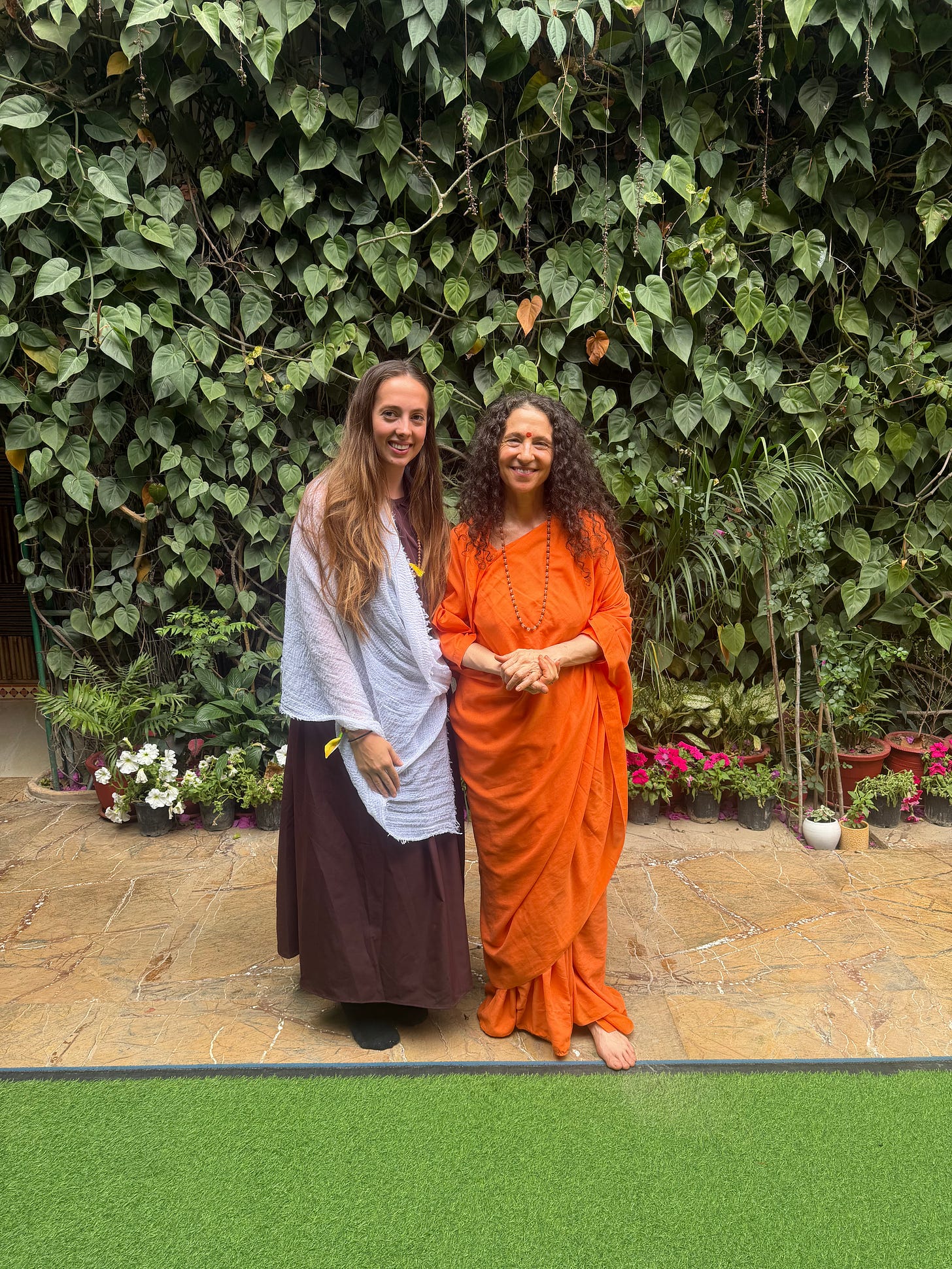
Months later, I found myself hearing her words again, this time not on the banks of the Ganges River, but inside the Los Angeles wellness studio where I teach sound baths, meditation and Yoga.
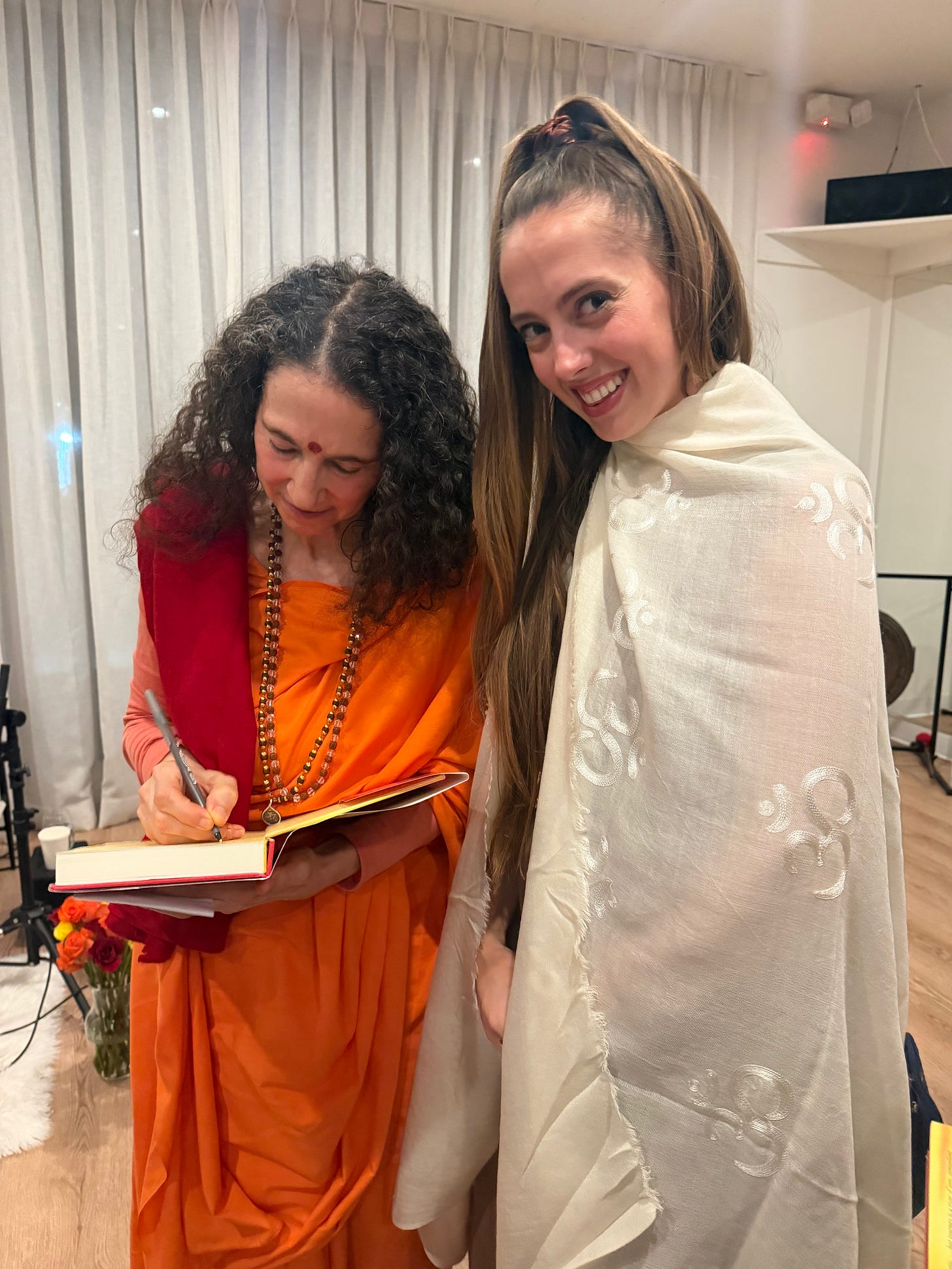
And strangely, the message felt even more relevant here.
Because while modern life may look different in different places, so many of us are still struggling with the same things.
Stress.
Burnout.
Loneliness.
Disconnection.
Comparison.
Emotional exhaustion.
The feeling that no matter how much we achieve, produce, consume, or optimize ourselves, something still feels missing.
Throughout the evening, Sadhviji spoke about yoga, spirituality, community, and the human tendency to search for fulfillment outside of ourselves.
But what struck me most was how deeply applicable these teachings still are in modern life.
Not as religion.
Not as dogma.
Not as something distant or inaccessible.
But as practical tools for navigating what it means to be human.
The Healing Power of Community
One of the first things Sadhviji said that stayed with me was:
“The answer to that which ails us, on individual levels, on collective levels, on global levels, is gathering in community.”
She spoke about the Sanskrit word satsang, which loosely translates to “gathering in truth.”
Not just being around people.
Not scrolling beside each other.
Not existing near one another while emotionally disconnected.
But true presence.
True connection.
A shared search for truth, healing, meaning, and awareness.
As she spoke, I kept thinking about how isolated modern life has quietly become.
We live in a time where almost everything can happen through a screen.
You can work online.
Order food online.
Take classes online.
Date online.
Learn yoga online.
Meditate online.
And while technology can absolutely be beautiful and helpful, many of us still feel profoundly disconnected.
Research from the U.S. Surgeon General has identified loneliness and social isolation as a growing public health concern, linking chronic disconnection to increased risks of anxiety, depression, cardiovascular disease, cognitive decline, and nervous system dysregulation.
Harvard researchers studying adult development over decades found that the strongest predictor of long term wellbeing was not wealth, fame, productivity, or achievement.
It was meaningful human connection.
And suddenly her words felt less philosophical and more deeply practical.
Maybe healing was never meant to happen entirely alone.
As someone who teaches meditation and sound healing in Los Angeles, I see this constantly.
People often walk into class exhausted.
Burnt out.
Emotionally overwhelmed.
Disconnected from their bodies.
Disconnected from themselves.
But something shifts when people breathe together.
Sit together.
Listen together.
Rest together.
The nervous system responds to safety.
And community creates safety.
Yoga Was Never Just About Flexibility
Sadhviji also spoke about something I think has become deeply misunderstood in modern wellness culture.
Yoga.
“Yoga,” she reminded us, “means union.”
Not performance.
Not aesthetics.
Not flexibility.
Not becoming more impressive.
Union.
A remembering.
A reconnection between the individual self and something larger.
As she spoke, I thought about how many people first encounter yoga through physical fitness culture.
And while movement itself can absolutely be healing, it is easy for the deeper intention of yoga to quietly disappear.
Especially in a culture that constantly tells us we need to become more.
More productive.
More beautiful.
More successful.
More optimized.
One of the most impactful moments of the evening was when Sadhviji reflected on a teaching from the Bhagavad Gita about the internal causes of suffering.
She shared the original Sanskrit:
“Kama, krodha, tatha lobha… these three are the gates to hell.”
Then she explained:
“The reason we are stuck, the reason that we are living in what today we would call hell, is because of three things: lust or craving, greed, and anger. These three things are actually the gates to a hellish life.”
But what stayed with me even more deeply was the way she expanded on it.
“All three of them are rooted in the ignorance of lack and separation. Lust says, ‘gotta have it, gotta have it, gotta have it.’ Greed says the same thing. Anger says, ‘how dare you not give it to me?’ Every one of those is predicated on the idea that we are lacking, that there is something outside of ourselves we desperately need in order to be whole.”
She continued:
“It objectifies ourselves and objectifies others. I am an object that happens to be lacking. You are an object that can fulfill that lack. Or you are an obstacle preventing me from getting what I want.”
But what struck me most was the way she explained it.
Not as punishment.
Not as morality.
Not as religious fear.
But as psychology.
As nervous system suffering.
She explained that all three are rooted in the illusion of separation and lack.
The feeling that:
something is missing
we are incomplete
fulfillment exists somewhere outside of ourselves
another person, achievement, possession, identity, or outcome will finally make us whole
And honestly, that feels incredibly relevant to modern life.
So much of modern culture quietly reinforces the belief that we are perpetually lacking.
Social media tells us we should look different.
Productivity culture tells us we should achieve more.
Advertising tells us we should buy more.
Wellness culture sometimes even tells us we should heal faster.
And eventually many people become trapped in cycles of craving.
Craving validation.
Craving certainty.
Craving attention.
Craving success.
Craving escape.
Sadhviji described how these states narrow our vision and disconnect us from one another.
“They contract our vision. They give us tunnel vision. We lose ourselves mentally, physically, emotionally because we become convinced that something outside of us is what we need in order to finally feel whole.”
That line stayed with me.
Because I think many people including myself are exhausted from trying to earn enough, achieve enough, or become enough in order to finally feel at peace.
The irony is that so many wellness practices are actually trying to return us to the very thing we lost in the first place:
Presence.
Connection.
Awareness.
Wholeness.
A PRACTICE FOR RETURNING TO PRESENCE
If you are feeling overwhelmed, your mind has been stuck in loops of overthinking, uncertainty, or emotional overwhelm, my Stop Overthinking Fast meditation may also support you:
Sometimes returning to ourselves begins with something very small.
A breath.
A pause.
Five quiet minutes.
Why Ancient Practices Still Matter
One thing I appreciated deeply about Sadhviji’s talk was that it never felt performative or overly abstract.
It felt grounded.
Human.
Applicable.
At one point she said:
“We are not machines.”
And I think we need to hear that right now.
Because modern culture often rewards constant output while quietly punishing rest.
Many of us have normalized:
nervous system dysregulation
chronic stress
overstimulation
sleep deprivation
emotional burnout
digital exhaustion
constant comparison
hyper productivity
And eventually the body responds.
Anxiety.
Fatigue.
Brain fog.
Inflammation.
Emotional numbness.
Burnout.
More and more research now supports what ancient spiritual traditions have been teaching for thousands of years.
Meditation has been shown in studies from institutions like Harvard Medical School to support stress reduction, emotional regulation, and changes in brain regions associated with attention and self awareness.
Breathwork practices can help regulate the autonomic nervous system and support vagal tone, helping shift the body out of chronic fight or flight states.
Sound meditation and vibrational practices are increasingly being studied for their effects on stress reduction, nervous system regulation, and emotional wellbeing.
These practices have endured for generations not because they are trendy, but because they help human beings return to balance.
Sound, Presence, and the Nervous System
One of the most beautiful moments of the evening was hearing Sadhviji speak about sound.
She said:
“Sound is energy.”
But more than that, she described devotional sound as something capable of “reconstructing the very nature of the way our hearts and minds function.”
As someone who works with sound healing professionally, this resonated deeply.
Because while sound baths may appear calming from the outside, what many people are actually experiencing is a shift in their nervous system.
For many people, stillness itself feels unfamiliar.
Rest feels uncomfortable.
Silence feels unsafe.
Sound can become a bridge.
A way back into the body.
A way back into the breath.
A way back into presence.
And perhaps most importantly, a reminder that healing does not always happen through force.
Sometimes it happens through softening.
Modern Life & Returning to Ourselves
What would it look like, to clear away the beliefs, fears, attachments, and patterns that no longer serve us?
To stop carrying the anger.
The comparison.
The illusion that we are somehow separate from one another.
And instead create space for:
compassion
truth
connection
awareness
love
presence
peace
I think that is what so many people are actually searching for right now.
Not necessarily more information.
Not more productivity hacks.
Not another self optimization strategy.
But a way back to themselves.
And maybe that is why practices like yoga, meditation, sound healing, prayer, chanting, breathwork, and community continue to endure.
Because beneath all of the noise of modern life, many of us are still searching for the same thing.
Connection.
Meaning.
Peace.
Belonging.
Not somewhere outside of ourselves.
But within ourselves.
And with each other.
Thank you, Sadhviji, for the reminder.
And for anyone looking to explore these practices more deeply, I share free guided meditations, nervous system resets, and sound baths on my YouTube channel, Peaceful Place Wellness. From short meditations for anxiety and overthinking to longer sound baths for sleep, grounding, and emotional reset, my hope is to create accessible spaces for people to reconnect with themselves in the middle of everyday life.
With love,
Angela
Peaceful Place Wellness
This essay first appeared on my Substack. Subscribe for new writing on sound, rest and the nervous system.
Subscribe on SubstackTHE PART OF SPRING NO ONE TALKS ABOUT
How Sound Healing Supports Emotional Renewal
There’s a moment in spring..
After the first blooms.
After the light has already started to stretch the days longer.
After the world has technically “awakened”…but before you fully feel like you have.
Read the full articleClose article
That’s where we are now.
And if you’ve been feeling a little behind, a little heavy, or like the energy of “new beginnings” hasn’t quite landed… you’re not off track. (me too lol)
You’re in the middle of the real process.
Spring isn’t just something you see.
It’s something your body moves through.
Research shows that with increased daylight, the brain produces more serotonin, supporting mood, energy, and emotional openness. Studies in The Lancet have even linked sunlight exposure to increased serotonin synthesis, while broader research in seasonal biology shows that our immune system, mood, and energy levels shift as the seasons change.
In simple terms, your body is waking up.
But awakening doesn’t always feel like clarity.
Sometimes it feels like… everything rising at once.
The Emotional Side of Awakening
As the nervous system begins to move out of winter’s slower, more protective state, something subtle happens.
According to the principles of Polyvagal Theory, our bodies are constantly scanning for cues of safety. And when those cues increase, through warmth, light, and environmental change, we naturally begin to shift out of shutdown and into connection and mobilization.
Which sounds beautiful in theory.
But in practice, it can feel like:
Old emotions resurfacing
A sudden need to change things
Restlessness, or even confusion
Moments of unexpected clarity followed by overwhelm
This is not you falling apart. (even if it feels like it, and for me personally it has been feeling like it, but)
This is your system reorganizing.
Why Sound Becomes So Powerful Right Now
This is where sound enters differently.
Not as something you listen to.
But as something that helps you process what’s already moving.
Sound works directly with the body’s internal rhythms.
Research in neuroscience shows that certain frequencies can guide the brain into alpha and theta states, the same states associated with deep meditation, emotional processing, and neuroplasticity. Music has also been shown to activate dopamine pathways in the brain, increasing motivation, emotional release, and a sense of reward.
And beyond the brain, vibration interacts with the body itself.
Low-frequency sound has been linked to stimulation of the vagus nerve, a key pathway in regulating stress, digestion, and emotional balance. When this system is supported, the body can shift out of tension and into a state where it can actually release.
Which is what spring is asking of you.
Not to become something new overnight.
But to gently let go of what you’ve been holding.
What Renewal Actually Feels Like
We often imagine renewal as light, easy, and inspiring.
But more often, it feels like:
A deeper breath than you’ve taken in a while
Tears that don’t fully make sense
A desire to move, change, or create
Moments of stillness that feel unfamiliar, but are needed.
Like parts of you that went quiet in winter beginning to speak again.
A Simple Spring Sound Ritual
You don’t need an elaborate routine to meet this moment.
Just a few minutes of intentional space.
If you’re feeling overwhelmed or emotionally stirred, start here:
I’ve created a short guided meditation for anxiety and nervous system reset to help you ground and gently prepare for what’s beginning to awaken within you.
And for deeper rest, especially at the end of the day, you can listen to one of my sound baths for sleep, designed to calm the body and support emotional release while you rest.
40 Min Fall Asleep Fast Soundbath
If you’d rather stay offline, simply sit or lie down somewhere comfortable.
Inhale slowly through your nose.
Exhale gently through your mouth.
Let your body soften.
And if it feels right, ask yourself:
What part of me is ready to wake up?
Note From Angela:
You don’t need to force clarity.
You don’t need to have everything figured out.
You just need to stay present long enough to feel what’s already beginning.
Sound is one way back into that presence.
A way to listen, not just with your ears, but with your body.
A way to soften into change instead of pushing through it.
If you’re in the middle of it right now, the uncertainty, the emotion, the quiet shifts…
you’re not late.
You’re right on time.
A Place to Land
If you’re craving support in this season, I offer sound baths and meditation classes in Santa Monica, across Los Angeles and Virtually, created to help you regulate your nervous system, release emotional tension, and come back into your body.
You can:
join me for an in-person sound bath in LA
explore my guided meditations and sound healing sessions on YouTube
Or keep it simple.
Take a few minutes today to sit, breathe, and listen.
That’s where it begins.
🤍 Angela, Peaceful Place
This essay first appeared on my Substack. Subscribe for new writing on sound, rest and the nervous system.
Subscribe on SubstackWHAT INDIA TAUGHT ME ABOUT YOGA, AYURVEDA, AND FINDING PEACE WITHIN THE CHAOS
If you think peace comes from the right place or routine, this might shift that.
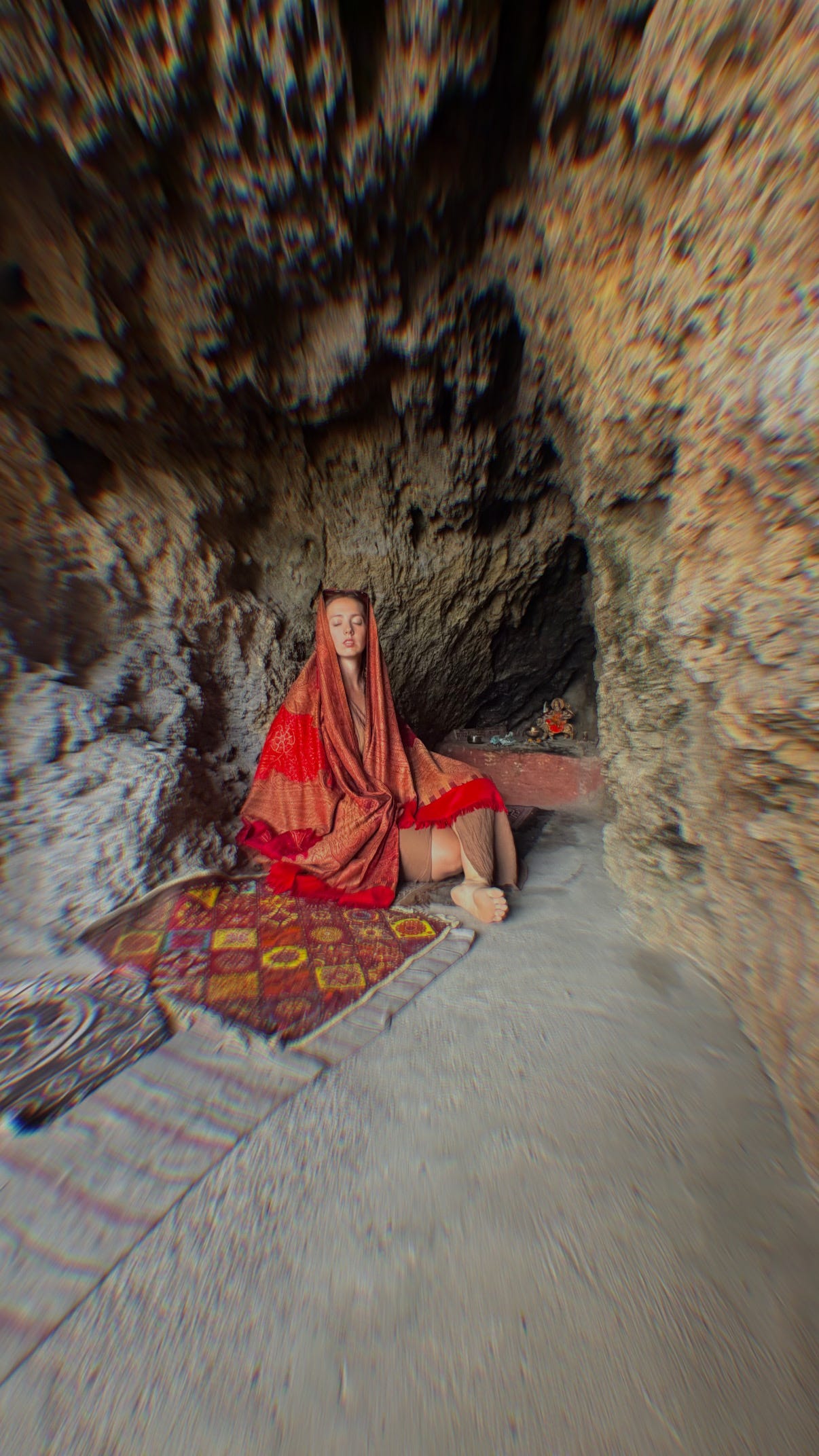
I traveled to Rishikesh with a quiet expectation.
That I would arrive… and feel peaceful.
That the birthplace of yoga would somehow offer stillness automatically.
That the environment itself would create the experience.
Read the full articleClose article
I didn’t say that out loud.
But I think I believed it.
That if I placed myself in the “right” place…
something in me would finally settle.
Instead, I was met with something much more alive.
Sound.
Movement.
Devotion.
Intensity.
The kind of intensity that you don’t get to control.
Moments of beauty layered with moments of overwhelm.
Moments where I felt completely present…
and moments where I felt like I needed to escape my own body for a second.
And somewhere in the middle of all of it, something shifted.
Not all at once.
But slowly.
I Thought Peace Would Feel Quiet
There’s this idea we’re sold, especially in wellness spaces, that peace looks a certain way.
Soft lighting.
Silence.
A perfectly curated environment.
And to be fair… those things help.
But India didn’t offer that version.
It was loud in a way that didn’t stop.
Not just occasional noise… constant.
Horns layered over voices.
Voices layered over music.
Movement everywhere.
There were moments sitting in traffic where I could feel my body tighten.
Like my system was trying to brace against it.
Wanting it to stop.
Wanting to control something.
And then realizing… I couldn’t.
Nothing was going to quiet down just because I wanted it to.
And I remember having this thought:
Okay… so what now?
Because the usual strategy is:
change the environment
remove the noise
create calm externally
But that wasn’t an option.
So something else had to happen.
And I started to notice these small moments.
Where instead of resisting it…
I softened.
Just slightly.
Took a breath.
Let the sound be there without trying to push it away.
And in those moments, something inside of me got quieter.
Not the world.
Me.
And that’s when it really landed:
Peace isn’t the absence of chaos.
It’s your relationship to it.
The Ashram Is Inside You
This one hit me in a way I wasn’t expecting.
Because if I’m being honest, part of me wanted the ashram to be “the thing.”
Like:
this is where it happens
this is where I’ll feel it
this is the container that creates the state
But I noticed something almost immediately.
You can be in the most “spiritual” environment…
and still be in your head.
Still thinking.
Still comparing.
Still distracted.
And that was confronting.
Because it removed the illusion that the place was going to do the work for me.
There were moments sitting in ceremony where my mind was wandering.
Thinking about home.
Thinking about my life.
Thinking about my relationship.
Thinking about everything except what was right in front of me.
And I remember catching myself and thinking:
Wait… I’m literally in India, at an ashram, and I’m still here in my mind.
And then the flip side of that:
There were moments later, back in more ordinary settings…
where I felt completely present.
No ritual.
No structure.
No “spiritual” environment.
Just… awareness.
And that’s when it clicked:
The ashram isn’t a place you go to.
It’s a state you access.
And that state doesn’t belong to India.
It’s available anywhere.
Which is both empowering…
and slightly inconvenient.
Because it means you don’t get to outsource it.
Ritual, Devotion, and Collective Energy
Every evening at the Ganga felt like stepping into something ancient.
The air would start to shift before anything even began.
People gathering.
Movement increasing.
This subtle build of energy.
Then the fire.
The chanting.
The rhythm of it.
At first, I felt like I was watching it.
Trying to understand it.
Trying to “get it right.”
And then at some point, I stopped doing that.
And I just let myself be inside of it.
And that’s when it started to feel different.
Because ritual isn’t about understanding every piece.
It’s about letting your body experience it.
The repetition of sound.
The predictability of movement.
The shared attention of hundreds of people focused on the same thing.
Your nervous system starts to organize around that.
You don’t have to force yourself into presence.
It happens through rhythm.
And the collective aspect…
that really stayed with me.
Because there’s something regulating about not being alone in it.
About feeling like you’re part of something bigger than your individual experience.
Letting Go (And Actually Meaning It)
The river practice felt simple on the surface.
Write something down.
Offer it to the water.
But it hit deeper than I expected.
Because I realized how attached I am to my own thoughts.
Even the ones that don’t serve me.
We say we want to let things go…
but a lot of the time, we’re still holding them.
Replaying them.
Identifying with them.
Keeping them alive in subtle ways.
Writing it down made it real.
There’s no avoiding it once it’s on paper.
And placing it into the river…
felt like a decision.
Not just a symbolic act.
But a moment of:
I don’t want to carry this in the same way anymore.
And watching it drift away…
without controlling where it went…
was uncomfortable and relieving at the same time.
Because it mirrored life.
You don’t always get to control what happens after you release something.
You just choose to release it.
Ayurveda and the Shock of Feeling Regulated
This one surprised me.
Because it wasn’t dramatic.
It was subtle.
Slow.
Almost easy to miss if you weren’t paying attention.
But I started noticing how my body felt.
Less rushed.
Less reactive.
Less on edge.
And I had this moment where I thought:
Oh… this is what it feels like to not be in fight or flight.
And that hit.
Because it made me realize how normal that state has become.
Running on low-level stress.
Constant stimulation.
Always slightly activated.
Ayurveda doesn’t come in and shock your system.
It softens it.
Brings it back into rhythm.
And that felt… sustainable.
Not like a peak experience.
But like a baseline shift.
Karma Yoga: How You Do Things Matters
Before this trip, I thought of karma in a pretty surface-level way.
Cause and effect. Good vs bad.
But what I learned is much simpler.
Karma just means action.
And Karma Yoga is about:
how you act
why you act
and whether you’re attached to the outcome
It brings the practice into everyday life.
Not just what you’re doing…
but how you’re doing it.
With presence?
With awareness?
Or just reacting?
India Is the Land of “And”
This might be the hardest thing to explain.
Because it’s not one thing.
It’s everything.
India doesn’t resolve itself for you.
It doesn’t clean itself up to make it easier to understand.
It just… is.
Messy and sacred.
Beautiful and overwhelming.
Grounding and destabilizing.
There were moments I loved it.
And moments I felt completely out of place.
And instead of trying to pick one…
I started to see that both were true.
At the same time.
And I think that’s something I’m still integrating.
Because we’re so used to wanting clarity.
Wanting things to make sense.
Wanting to define an experience as good or bad.
But some experiences are just… expansive.
They don’t fit into one category.
What Stayed With Me
When I really sit with it…
this is what I’m carrying forward:
That peace isn’t something you wait for externally.
That the environment can support you, but it doesn’t define your state.
That you don’t have to fully understand something to experience it.
That your body responds to rhythm, to repetition, to presence.
That letting go is a choice you make over and over again.
That balance feels unfamiliar when you’ve been living in subtle stress.
That you can hold multiple truths at once.
And maybe the biggest one:
That nothing out there is going to give you something you don’t already have access to.
It just makes it easier to see.
So What Now
Now I’m back.
Back in my normal environment.
My routines.
My relationships.
My patterns.
And the question isn’t:
What did I experience there?
It’s:
Can I live any of this here?
Can I pause before reacting?
Can I breathe when things feel overwhelming?
Can I let something go instead of holding it?
Can I come back to myself without needing everything around me to change?
Because that’s the practice.
Not the place.
There’s a part of me that thought I had to go somewhere far away to access this.
But now I see:
the practice was never the place.
It was always the returning.
With love,
Angela
Peaceful Place 🤍
This essay first appeared on my Substack. Subscribe for new writing on sound, rest and the nervous system.
Subscribe on SubstackSOUND BATHS AND THE NERVOUS SYSTEM: WHY SOUND HEALING HELPS US RESET AND REAWAKEN
A guide to the science of sound meditation, nervous system regulation, and seasonal renewal.
Congratulations, you made it through the darkest part of the year.
January and February can often feel like a lot. They can place unrealistic expectations on what our lives should look like or who we should suddenly become in the dead of winter.
Read the full articleClose article
So cheers to the time change, the clock shifting forward, and the days becoming a little longer. We might lose an hour of sleep to get back on schedule, but if it means I can take sunset walks again after work, I will happily accept the trade.
Sometimes in the darkest days we get to invite a new awareness into our lives. We get to reconnect with the parts of ourselves that have been hibernating. Slowly we begin to notice the small blooms appearing within us and in the earth, quietly emerging to say hello again.
I recently had a birthday, and like many people do around that time, I found myself reflecting on where I have been and what has changed. The biggest transformation for me this year is something that no one else can see, but something I can deeply feel. Sometimes that is the most beautiful kind of growth. You do not have to be the flashiest flower in the garden to be evolving.
This month feels like a bridge between stillness and movement.
A place where life begins to stir again.
Here are a few things I am inviting into my life as spring gets closer.
One is simple evening walks. I want to allow the morning light and evening light to reach my eyes and gently reset my circadian rhythm. Light exposure is one of the most powerful signals for the brain’s internal clock, helping regulate sleep, mood, and energy levels.
If you use your phone at night, I highly recommend switching it to red light mode. It is surprisingly easy to do and significantly reduces the blue light that can interfere with melatonin production. I would be happy to show you how if you are curious.
I also try to keep my house lighting soft once the sun sets. Instead of bright overhead lights, I transition to warmer or red toned lighting in the evening. When the sun is setting at eight instead of four in the afternoon, maintaining a natural rhythm with the day becomes much easier.
Have you ever noticed that in the spring you suddenly feel like becoming a new person?
You want to clean out your closet. Rearrange your furniture. Refresh your wardrobe. Maybe even start dating someone new.
I always find that impulse a little funny because so many of us seem to feel it at the exact same time.
March has always been one of my favorite months because it is when some of the biggest shifts in my life seem to happen. But there is actually real physiology behind that feeling.
As daylight increases, our bodies receive stronger signals through the eyes that help regulate circadian rhythms. Increased light exposure supports serotonin production, which influences mood, motivation, and emotional resilience. Warmer temperatures, longer days, and more time outdoors all subtly tell the nervous system that it is time to wake up again.
But that awakening does not have to be drastic.
Something I find interesting as a sound healing facilitator is that many people stop prioritizing practices like meditation, rest, or sound baths as spring arrives. The days are longer, energy is higher, and suddenly everyone feels like they need to be doing more.
Doing is beautiful. Movement is natural in this season.
But it is also worth remembering that the science of sound and vibration can support that sense of renewal. Sound can act as a kind of internal reset for the nervous system.
Why Sound Can Support Your Nervous System in Spring
Sound meditation has been shown to reduce tension, anxiety, and fatigue, while helping the brain enter slower wave states associated with creativity and restoration.
When we experience sound baths, the vibration of instruments such as crystal bowls interacts with the body through resonance, helping guide the nervous system toward a more balanced state.
In other words, sound can help the body integrate change rather than simply push through it.
What Sound Meditation Can Support
Research and experience both suggest that sound practices can help with:
• reducing stress and nervous system overload
• easing tension in the body
• supporting emotional processing
• encouraging slower brainwave states associated with relaxation and creativity
• improving mood and overall sense of wellbeing
Why I Use Sound During Seasonal Transitions
This is why I like to incorporate vocal toning and gentle sound practices into my own routine during times of transition.
Even when life becomes busy or full of movement, these moments help me reconnect with the parasympathetic nervous system, the part of the body responsible for rest, digestion, and repair.
Spring is a time of growth, but it is also a time to protect your energy.
It is easy to burn yourself out chasing momentum before summer even arrives.
Instead, think of this season as a chance to restore clarity while things are beginning to move again.
A Few Reflection Questions for This Season
If you feel called to journal this month, here are a few prompts to sit with:
• What part of me is beginning to wake up again?
• What am I ready to release from the winter season?
• What small step would feel supportive for my nervous system right now?
Simple Rituals I Am Practicing Right Now
Some of the practices I have been leaning into lately include:
• vocal toning and humming
• regular sound bath practice
• evening walks and natural light exposure
• creating quiet moments for the nervous system even during busy days
Sound, in many ways, heals the space between winter and bloom.
Practices like sound baths are not only helpful when we feel burned out or exhausted. They can be equally supportive during seasons of movement, helping the body integrate growth rather than rush past it.
A Personal Note
Tomorrow I leave for India to begin my own adventure.
The days will be long. I will be practicing yoga, meditating, traveling, and learning from early morning until late evening. I know I will be tired, but I hope to return with new stories, deeper understanding, and a greater appreciation for the history and traditions that many of our modern wellness practices come from.
If you are curious about how I have been preparing my body for the trip, from jet lag strategies to nervous system support while traveling, I would be happy to write about that as well. Feel free to leave a comment and let me know if that would be interesting to you.
Until then, may this season bring gentle awakening, curiosity, and space for the small blooms within you to grow.
With peace and love,
Angela
Peaceful Place
This essay first appeared on my Substack. Subscribe for new writing on sound, rest and the nervous system.
Subscribe on SubstackThe Courage to Change Pace
Fire, Freedom, and a Calm Nervous System
Today is an opportunity to let go.
The Lunar New Year begins again, and this year is the Year of the Horse. We get to change the pace in which we have been moving. We get to move with strides of courage and pride.
Read the full articleClose article
My mom is a Horse, so shoutout to my momma.
When I think about a horse running, I think about how free they look when they finally get to run wild. Muscles strong. Mane flying. No hesitation. No second guessing. Just instinct and motion.
What would it look like if we allowed our creativity, motivation, hopes, and dreams to run wild into our reality?
And here is the real question.
Could we liberate ourselves from fear and still keep a calm nervous system?
Because running wild is beautiful.
Burning out is not.
Fire, But Regulated
The energy of the Horse feels bold. Decisive. Forward moving.
Maybe this is an opportunity to switch things up. To move forward without overanalyzing every step. To shed an old skin and form a new one.
I have always thought New Year landing in the dead of January felt a little off. It is cold. It is dark. The body wants to hibernate.
But Lunar New Year follows the moon. It honors cycles. It waits for light to begin returning.
So if your year is not off to the start you imagined, maybe this is your second beginning.
And maybe this time, the goal is not intensity.
Maybe it is sustainability.
Wellness and longevity are not built on adrenaline. They are built on nervous system regulation. Chronic stress elevates cortisol, disrupts sleep, impacts digestion, and slowly chips away at our resilience.
Courage without regulation becomes exhaustion.
Ambition without grounding becomes anxiety.
But fire with breath?
Fire with rest?
That becomes power.
Letting Go vs Giving Up
While we celebrate Lunar New Year, I also find myself reflecting on a holiday from the culture I was raised in. Catholicism. I do not know that I identify with it in the same way anymore, but Lent was always a tradition that resonated with me. Giving something up for a season.
As kids it was candy. Video games. Soda. And we counted down the days until we could have it back. My As an adult, sacrifice feels different. It feels more intentional.
When we think about giving something up, we imagine loss. But what if there is something to be gained?
What could happen if we leaned into one thing and backed out of another?
Saying yes to one thing requires saying no to something else.
Saying yes to rest might mean saying no to constant availability.
Saying yes to creativity might mean saying no to perfectionism.
Saying yes to growth might mean gently loosening a dynamic that no longer fits who you are becoming.
This is not about cutting people off or dramatically reinventing yourself. It is about recalibration. And recalibration is nervous system work.
The Nervous System and Freedom
Here is something important.
If your nervous system has been living in fight or flight, in planning, overanalyzing, controlling, or bracing, the idea of “running wild” might actually feel unsafe.
Freedom is easier when the body feels regulated.
The parasympathetic nervous system, the branch responsible for rest, digestion, hormone balance, and emotional clarity, must come online regularly for us to thrive long term.
You cannot build longevity on constant urgency.
You cannot create sustainably from chronic stress.
If you want your ideas to run wild, your body must feel safe.
Practical Ways to Change Pace Without Burning Out
If this feels like a season of letting go or beginning again, here are a few grounded ways to support your nervous system while you do it.
1. Breathe Before You Leap
Before making big decisions or starting something new, inhale for four counts and exhale for six. Longer exhales stimulate the vagus nerve and tell your body it is safe.
2. Regulate Daily, Not Occasionally
Meditation. Loving kindness. Humming. Sound baths. Gentle walks without a destination. These are not luxuries. They are nervous system hygiene.
3. Support the Body Physically
Magnesium rich foods. Hydration. Sleep consistency. Sunlight exposure. Cacao in moderation. Ceremonial cacao contains magnesium and theobromine, which can gently support heart awareness without the spike of caffeine.
4. Journal What You Are Ready to Release
Instead of “What should I give up?” ask,
“What am I ready to let go of so that I can grow?”
Sometimes it is clutter.
Sometimes it is self criticism.
Sometimes it is overcommitting.
5. Redefine Discipline
Discipline does not have to mean punishment. It can mean devotion. Devotion to your peace. Devotion to your health. Devotion to longevity.
Running Wild on the Beach
I keep picturing a horse running down the beach.
Strong. Free. Fully alive.
But even wild horses rest.
Maybe this season is not about sprinting.
Maybe it is about aligning.
Maybe it is about moving forward with courage and pride, but not abandoning your body in the process.
You do not have to burn to prove that you are passionate.
You do not have to suffer to prove that you are disciplined.
You do not have to rush to prove that you are growing.
You can move boldly.
You can move freely.
And you can do it with a regulated nervous system.
Maybe today you journal.
Maybe you clear a drawer.
Maybe you lean into a new friendship.
Maybe you simply breathe deeper.
Whatever it is, let it feel aligned.
With love, and an invitation to find steadiness inside your fire.
Angela
Peaceful Place
This essay first appeared on my Substack. Subscribe for new writing on sound, rest and the nervous system.
Subscribe on SubstackSELF LOVE RITUALS FOR CALMING THE NERVOUS SYSTEM
Cupid, Cortisol, and Cacao: How Meditation, Sound Baths, and Self Compassion Rewire the Heart
February has a funny way of asking big questions.
The novelty of the new year has softened. Winter is still very much here. And suddenly the quiet can feel louder. Loneliness, restlessness, or a low grade sadness can sneak in, even when nothing is “wrong.”
Read the full articleClose article
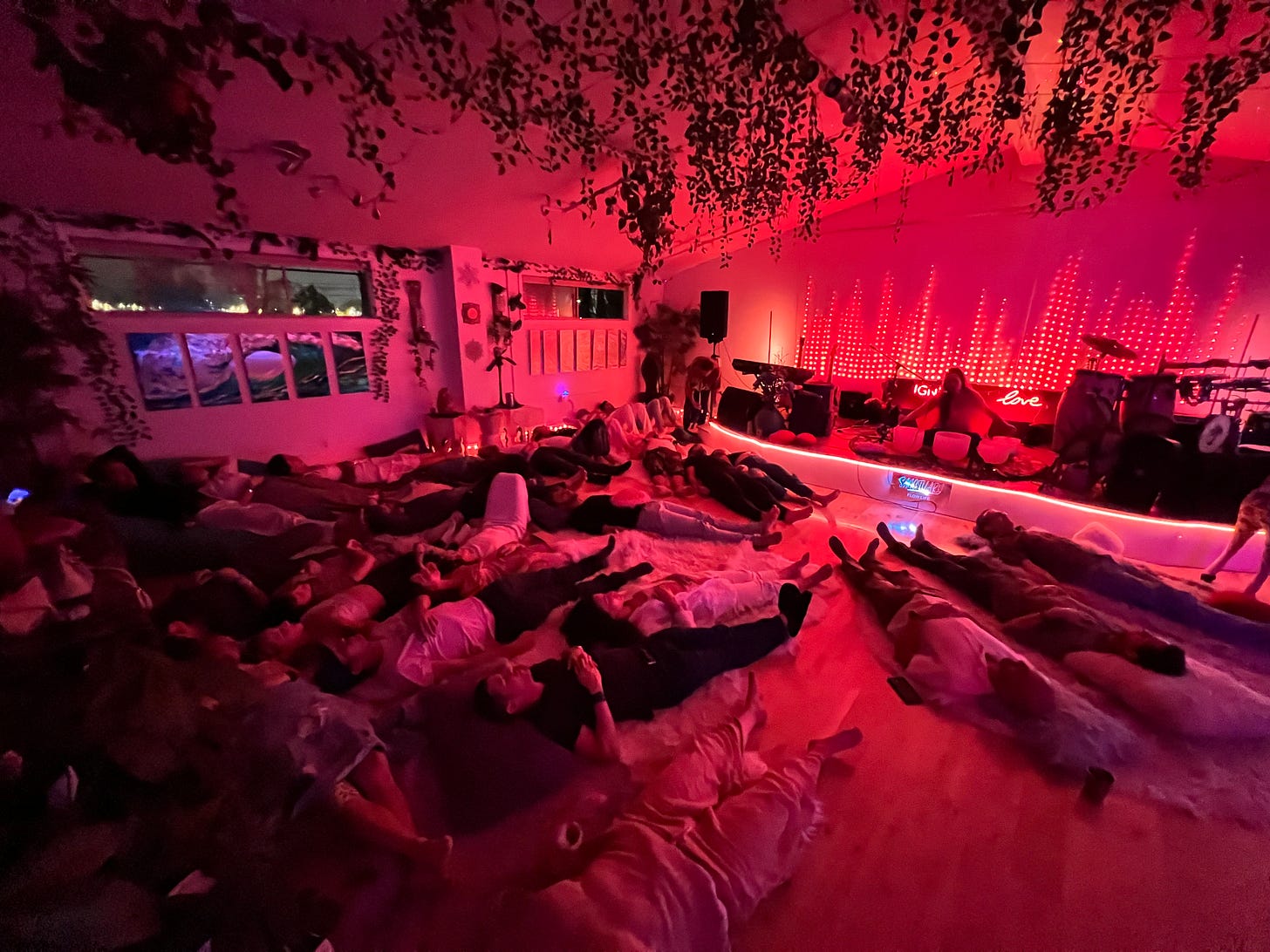
As a wise Miley Cyrus once said, you can buy yourself flowers. And as a young groundhog recently announced, there may be six more weeks of winter.
But what do we actually do with all that information?
For me, February is not about forcing positivity or pushing through. It is about learning how to tend to the heart gently, consistently, and without guilt. It is about self-love that feels lived in, not performative. The kind that helps your nervous system feel safe enough to soften.
Self Love Is a Nervous System Practice
Real self love is not just bubble baths and affirmations,( although that may be one of my personal favorite routines ahha). At its core, self love is the daily practice of noticing what your body and nervous system need, and responding with care.
If you need rest, rest.
If you need a walk, take it.
If you need a cookie, eat the dang cookie.
Balance is not about doing everything “right.” It is about finding the rhythm that makes you feel most alive, most steady, and most fulfilled. Some days, that rhythm is a baby step. Other days it is a grand gesture. Both count.
Science backs this up. When we consistently respond to ourselves with kindness rather than criticism, cortisol levels decrease, and emotional regulation improves. The nervous system learns that it is safe to slow down. Over time, this creates resilience, not laziness.
Why Winter Can Feel Heavy
Winter sadness and loneliness are not personal failures. Reduced daylight can disrupt circadian rhythms and serotonin production, and social isolation can activate the same stress pathways as physical danger.
Your body is not broken. It is responding to its environment.
This is why February invites practices that create warmth from the inside out. Not hustle. Not reinvention. Just care.
Why Softening Can Feel Scary
Here is something no one tells you. If your nervous system has learned safety through control, productivity, or vigilance, slowing down can feel uncomfortable at first. Softening may feel unfamiliar. Even unsafe.
This does not mean you are doing it wrong. It means your system is learning something new.
Gentle practices allow the parasympathetic nervous system, the part responsible for rest, digestion, and emotional openness, to come back online. That is where healing happens.
Practices I Love for Heart Opening and Emotional Warmth
Loving Kindness Meditation
Also known as metta meditation, this practice involves offering phrases of goodwill to yourself and others. Research shows it increases positive emotions, reduces self-criticism, and improves heart rate variability. You are not forcing love. You are offering it, and letting your body receive it at its own pace. 10 Minute practice on YT Here
Self-Compassion Meditation
Self-compassion lowers stress hormones and activates the caregiving system in the brain. In simpler terms, it helps you become your own emotional support person. Less inner villain, more inner best friend.
Sound Baths and Singing
Sound is one of the most effortless ways to calm the nervous system. Sustained tones and harmonic frequencies shift the brain into relaxed alpha and theta states, where emotional processing and integration happen naturally. You do not have to try. You just listen.
This is why sound healing feels like being held. The body softens without needing instructions.
Cacao, Chocolate, and the Heart
Cacao has been used ceremonially for centuries by indigenous cultures as a heart opening plant medicine. It contains magnesium, which supports nervous system relaxation, and theobromine, which gently increases blood flow and heart awareness.
Long before Valentine’s Day marketing, cacao was associated with connection, ritual, and reverence.
Somewhere along the way, capitalism wrapped it in pink foil and told us love had to be exchanged, purchased, or proven. But the heart connection remained.
You do not need a holiday or a partner to work with cacao intentionally. A warm cup, a quiet moment, and an honest intention are enough.
One of my personal favorite cacao brands i use is Holy Cacao. Holy Cacao is a Ceremonial cacao made from whole cacao beans, stone-ground into a paste, so it keeps its natural fats, magnesium, and theobromine. That’s why it feels different in the body. I include cacao in my routine and in my sound and meditation work because it supports presence and heart awareness without overstimulating the nervous system.
You can use the code Angela10 for 10% off your order.
The Truth About Motivation
Sometimes you do not want to go. To the class, the walk, the gathering, the practice.
Then you go anyway. And afterward, you realize you are glad you did.
Motivation often follows action, not the other way around. Self love is not waiting until you feel perfect. It is showing up imperfectly and letting that be enough.
A Love Story With Yourself
Think of February like a rom com where Cupid accidentally aims the arrow inward.
You are both the main character and the steady guide. The one learning, and the one cheering from the sidelines. You are allowed to enjoy your life, even in the middle of winter. Especially in the middle of winter.
Gentle Reflections
What does my nervous system need today?
Where can I soften instead of push?
What would self love look like if it did not have to be earned?
What small gesture could bring warmth into this moment?
February is not asking you to fall in love overnight. It is asking you to practice choosing yourself, one small, honest gesture at a time.
Sometimes that is rest.
Sometimes that is movement.
Sometimes that is chocolate.
All of it counts.
With love, and an invitation to find a little more space and calm wherever you are,
Angela
Peaceful Place
This essay first appeared on my Substack. Subscribe for new writing on sound, rest and the nervous system.
Subscribe on SubstackWELLNESS IS GETTING COMPLICATED, LET'S SIMPLIFY IT.
Simple wellness rituals for winter, nervous system support, and finding your own definition of well being.
If you’ve spent more than five minutes online lately, you’ve probably been told that wellness requires at least one light panel, a cold plunge, magnesium in three different forms, glucose monitoring, a wearable ring, adaptogenic coffee alternatives, and maybe a grounding mat for your bed.
Add in breathwork, meditation, sound baths, sauna, fasting, supplements, detoxes, blue light glasses, vagus nerve toning, mushroom drinks, vegan versus carnivore debates, and suddenly “taking care of yourself” feels like a full time job.
Read the full articleClose article
It’s a lot.
And while many of these tools can be helpful, the truth is simpler and quieter than the wellness internet would have you believe.
You decide what wellness looks like for you.
Not trends.
Not algorithms.
Not what worked for someone else on a podcast.
Winter is the perfect season to come back to that truth.
THE PROBLEM WITH CHASING EVERY TREND
Biohacking can be fascinating. Dont get me wrong, I do plenty of my own lol. It can also be expensive, overwhelming, and anxiety-inducing if you’re constantly wondering whether you’re doing enough.
Science consistently shows that stress itself is one of the biggest drivers of poor health outcomes. In other words, if a “wellness” practice is making you more anxious than calm, it’s probably not serving you.
Ease matters.
Neuroscience shows that the nervous system changes best through small, consistent inputs rather than extreme interventions. When stress is lowered and safety is prioritized, the brain becomes more flexible, focused, and resilient.
Rome wasn’t built in a day, and neither is a regulated nervous system.
WHAT ACTUALLY WORKS, SCIENCE AND ANCIENT WISDOM AGREE
When we look at long-lived populations, often referred to as the Blue Zones, we don’t see extreme biohacking. We see simple, repeatable practices that have been around for thousands of years.
Things like:
Daily movement
Community and connection
Purpose
Rest
Time outdoors
Simple food
Consistent routines
Modern science backs this up.
Sleep, for example, is still the most powerful and underrated biohack available. There is very little that quality rest does not improve, from mood and metabolism to immune function and cognitive clarity.
Meditation and breathwork are also strongly supported by research for reducing stress, improving focus, and supporting emotional regulation, even when practiced for just a few minutes a day.
Sound and music have been used for healing across cultures for centuries, long before we had words like optimization or performance tracking. What works is often what’s been working all along.
FINDING YOUR OWN DEFINITION OF WELLNESS
Wellness is not one size fits all.
Some people ground through stillness, meditation, and sound.
Others ground through movement, hiking, running, or dancing.
Some find regulation through humming, singing, or vagal toning.
Others through breath, tai chi, qi gong, or gentle strength work.
There’s room for:
Meditation and sound baths
Breathwork and humming
Walking, hiking, or time in nature
Gentle fasting or simply eating warm, nourishing food
Coffee, tea, matcha, or mushrooms
Supplements or none at all
The key question is not, “Is this trending?”
It’s, “Does this feel supportive in my body?”
If something causes more anxiety than peace, drop it.
If it creates rigidity instead of flexibility, pause.
If it disconnects you from yourself, it’s not wellness, no matter how popular it is.
Your body is the authority.
WINTER, SEASONALITY, AND MENTAL HEALTH
Winter naturally asks us to slow down. Reduced daylight affects circadian rhythms and melatonin production, which can impact mood and energy levels. This is why seasonal affective symptoms are common, and why winter wellness needs to emphasize gentleness, warmth, and nervous system support.
Helpful winter supports include:
Morning light exposure
Earlier bedtimes
Warm food and drinks
Reduced alcohol and stimulants
Short daily practices that regulate the nervous system
You don’t need to do everything. You need to do a few things consistently.
MY HIGHEST RECOMMENDATIONS (KEEP IT SIMPLE)
If everything else feels noisy, start here.
A short daily meditation, sound practice, or breath practice
Consistent sleep and rest
Gentle movement
Creating a calm, supportive environment
This is where sound baths, meditation, and Yoga Nidra shine. They meet the nervous system where it is and guide it gently back toward balance.
This is why my work always comes back to sound, stillness, and simplicity. These practices are accessible, effective, and free of performance pressure.
If you want support, you can explore my guided meditations and sound baths, join a live Yoga Nidra and sound session, or experience a longer sound journey designed for winter rest and renewal.
You don’t need more information. You need integration.
INTEGRATING THESE RITUALS INTO DAILY LIFE
Morning Reset Ritual
3 minutes of breath
2 minutes of sound or music
1 minute of silence
This sets the tone for the entire day.
Evening Unwinding
Dim the lights, Light a candle
Limit screen time or stressors
Slow your breath
Let the day gently close
Journal Prompt
“What feels supportive right now, and what can I release?”
Affirmation:
I choose ease. I choose what supports my nervous system.
A PEACEFUL WAY FORWARD
Wellness doesn’t have to be extreme to be effective.
It doesn’t have to be expensive to be powerful.
And it certainly doesn’t have to be perfect.
Sometimes growth isn’t about adding more. It’s about removing what no longer serves you and creating an environment that aligns with who you’re becoming.
Day by day. Bit by bit. With compassion.
This January, you don’t need more pressure.
You need space in a peaceful place.
With care,
Angela
Optional Tools I Personally Use and Trust
Infrared Sauna Glow Light:
Discount Code: ANGELAWRIGHT
Link: https://sauna.space/angelawright
Echo Hydrogen Waterbottle + Prebiotics:
Discount Code: ANGELAWRIGHT40off
https://echowater.com/discount/ANGELAWRIGHT40off
Function Health Blood Tests:
Link: https://my.functionhealth.com/signup?code=AWRIGHT18&_saasquatch=AWRIGHT18
Shilajit Naturals:
Discount Code: angela_wright 10% off
Affiliate Link: buy.naturalshilajit.com/angelawright
This essay first appeared on my Substack. Subscribe for new writing on sound, rest and the nervous system.
Subscribe on SubstackTHE ENERGY OF LETTING GO: HOW SMALL SHIFTS CREATE REAL TRANSFORMATION
Why releasing pressure, simplifying your habits, and creating space can be the most powerful way to begin the year.
Winter has a way of telling the truth.
In the quiet after the holidays, when the light thins, the calendar clears, and the world exhales, we’re invited into our own softening.
Read the full articleClose article
As Ram Dass wrote, “The quieter you become, the more you can hear.”
Transformation doesn’t begin with addition.
It begins with space.
And yet, every January, we’re told the opposite.
Add more goals.
Add more discipline.
Add more productivity.
Add more pressure.
We try to fix our lives by stacking more onto already-full days adding tasks to our to-do lists, trying to stretch time we don’t actually have, expecting ourselves to become a completely new person overnight.
No wonder we burn out by February.
WHY TRANSFORMATION DOESN’T NEED TO BE A BIG LEAP
Here’s the truth most New Year’s messaging misses:
Transformation doesn’t require a dramatic overhaul.
It requires sustainable, loving shifts.
Five minutes of meditation, not a ten-day silent retreat.
A short walk, not signing up for a marathon.
Going to bed ten minutes earlier, not reinventing your entire routine.
This isn’t “settling for less.” It’s building something that actually lasts.
Behavior scientist BJ Fogg, author of Tiny Habits, says: “If you want a behavior to become a habit, make it tiny.”
He also reminds us that lasting change comes from reducing obstacles, not increasing pressure. When habits feel heavy, the system not you, is the problem.
This is especially important in winter, when your nervous system is biologically primed for slower rhythms, reflection, and restoration.
WHY LETTING GO FEELS HARD (SCIENCE + PSYCHOLOGY)
Letting go isn’t a mindset issue. It’s a nervous system issue.
When we’ve been in survival mode, overworking, people-pleasing, pushing past exhaustion, the body learns to grip. Muscles tighten. Breath shortens. The mind loops old stories because they feel familiar, even when they’re no longer helpful.
Neuroscience shows that rumination lives in the brain’s default mode network, which becomes quieter during meditation and deep rest. When that network softens, the mind becomes less sticky. Less attached. More spacious.
But release only happens when the body feels safe.
You can’t force yourself to let go.
You can only create the conditions where letting go becomes possible.
THE ENERGETICS OF LETTING GO (THE SUBTLE BODY LAYER)
On an energetic level, letting go isn’t about deleting your past or abandoning what shaped you.
It’s about choice.
You get to decide what you carry forward and what no longer deserves your energy.
Sometimes this looks like decluttering habits, beliefs, or expectations that were never yours to begin with. Other times, it’s deeper, stripping things back to the studs so you can rebuild on a solid foundation, rather than endlessly patching over the same cracks.
New beginnings don’t require erasing your history. They require discernment.
Winter teaches us this beautifully. Trees don’t apologize for shedding their leaves. They don’t cling to what once served them. They trust that release is what makes room for rebirth.
RITUALS FOR LETTING GO + BUILDING A NEW FOUNDATION
Letting go isn’t passive. It’s intentional.
Before we build anything new, we have to clear the ground it will stand on. Otherwise, we’re just stacking habits on top of exhaustion, guilt, and unrealistic expectations.
This is where tiny rituals matter, not because they’re impressive, but because they’re effective.
Here are a few practices to support both release and rebuilding:
1. Emotional Release Meditation (5 minutes)
👉 You can follow along with my 5-minute guided meditation here. designed specifically to help your nervous system downshift so release happens naturally.
Why this works (and why it’s not a “waste of time”)
Meditation improves focus and productivity.
Studies show that even short meditation practices reduce mind-wandering and improve attention regulation, helping you return to tasks more efficiently instead of operating from mental overload.A regulated nervous system = better decision-making.
When stress hormones drop, the brain shifts out of survival mode and into clarity, creativity, and presence which often makes the rest of the day feel easier, not heavier.
Five minutes of intentional rest can easily make you more productive, not less because you’re no longer dragging your nervous system through the day.
This is how you build a foundation that actually holds.
Smudging, A Ritual of Transition
An ancient practice used across many Indigenous cultures
Traditionally used to mark transitions, release what’s complete, and reset energy
Best used before meditation, sound, rest, or the start of a new season
How to use it simply:
Light sage or another sacred plant
Let the smoke move through your space
Set a quiet intention: “I release what no longer belongs here.”
Smudging isn’t about clearing everything away.
It’s about honoring what’s ending and making room for what’s next.
Sound as a Clearing Practice
Play a short soundbath or sit with a single sustained tone
Let the sound move through the body without effort
Notice where you soften, where you exhale, where you release
Sound helps the body let go before the mind needs to understand why.
2. Journal Prompt: Clearing
What am I holding onto out of habit, guilt, or fear?
What feels familiar but limiting?
What would change if I allowed myself to rest without apology?
3. Foundation Ritual
Choose one tiny habit that supports your nervous system:
5 minutes of sound or silence
One conscious breath before checking your phone (if you have not tried the “onesec” app.. its changed my screen time dramatically)
A short walk without productivity attached
Consistency matters more than intensity.
BUILDING A NEW FOUNDATION (WHAT ACTUALLY MATTERS)
This is where January gets real.
Not what should matter. Not what looks impressive online.
But what truly supports your energy, your time, your motivation?
Ask yourself:
What drains me vs. what nourishes me?
What expectations am I carrying that aren’t mine?
What would it look like to prioritize myself without guilt?
Optimizing your life isn’t just about routines. It’s about protecting your nervous system.
Your creativity. Your capacity to be present.
When you start there, everything else becomes clearer.
TRANSFORMATION BEGINS WITH EMPTY SPACE
Real change doesn’t come from doing more.
It comes from doing less on purpose.
This January, you don’t need to reinvent yourself.
You don’t need a hyper-disciplined overhaul or a perfectly optimized routine.
You need room.
When you start the day with the right internal posture, a regulated nervous system, a clear mind, a rested body everything that follows becomes more effective.
That five-minute meditation, the twenty-minute nap, the thirty-minute soundbath?
They’re not time lost. They’re the reason the rest of your day actually is more productive and feels better.
While the world chases goals like getting “ripped” in the gym, maybe this is the year you get emotionally, mentally, and energetically strong, not by grinding harder, but by choosing habits that support your mind first.
By capitalism’s standards, rest can look unproductive.
But from a nervous-system perspective, it’s often the most strategic move you can make.
So when you’re building your New Year’s habits, consider starting here:
Not with what you do, but with how you feel while doing it.
This January, you don’t need more pressure.
You need space in a peaceful place.
This essay first appeared on my Substack. Subscribe for new writing on sound, rest and the nervous system.
Subscribe on SubstackA Space to Slow Down
Welcome to Peaceful Place Exploring nervous system regulation, sound, and modern life
Hi, I’m Angela.
I teach meditation and sound baths, but more than that, I’m deeply curious about how people actually live inside their bodies and minds.
Read the full articleClose article
My work lives at the intersection of science and stillness, creativity and regulation, structure and softness. I’ve studied music, meditation, yoga, and sound healing, and I’ve spent just as much time learning through lived experience, anxiety, creativity, burnout, restlessness, joy, and the quiet moments that rearrange you.
Some days I’m writing from the meditation room, some days from the beach, some days from the middle of real life. I’m not here as a guru or an authority figure, but as someone walking alongside you, asking questions and sharing what I’m learning as I go.
Peaceful Place is an extension of how I teach, how I live, and how I return to myself.
Here’s what you can expect to find here,
Reflections on nervous system regulation and why it matters more than willpower.
Sound healing, meditation, and rest practices that actually fit into modern life.
Creative living, especially how creativity supports healing and vice versa.
Gentle science, research, and lived insight, translated into a cute little substack.
Personal reflections that are honest, grounded, and not overly polished.
If you’ve ever felt like traditional wellness advice made you more stressed instead of calm, or like you wanted depth without dogma, or practices that didn’t require becoming a different person, you’re in the right place.
This space is for people who want calm without bypassing reality, and meaning without pressure.
Why I’m Excited You’re Here
I’ve wanted a space like this for a long time.
A place where thoughts don’t need to be optimized into sound bites, where nuance is welcome, and where rest is treated as something intelligent and necessary, not indulgent.
Substack feels like a slower room on the internet, and I’m excited to build something here together. This will be a living space, evolving as I do, shaped by curiosity, conversation, and care.
If you’re here, thank you.
If you’re staying, I’m really glad.
Welcome to Peaceful Place.
With care,
Angela
May this be a place you return to when you need a little more space, a little more calm, and permission to rest, even for a moment.
This essay first appeared on my Substack. Subscribe for new writing on sound, rest and the nervous system.
Subscribe on Substack